


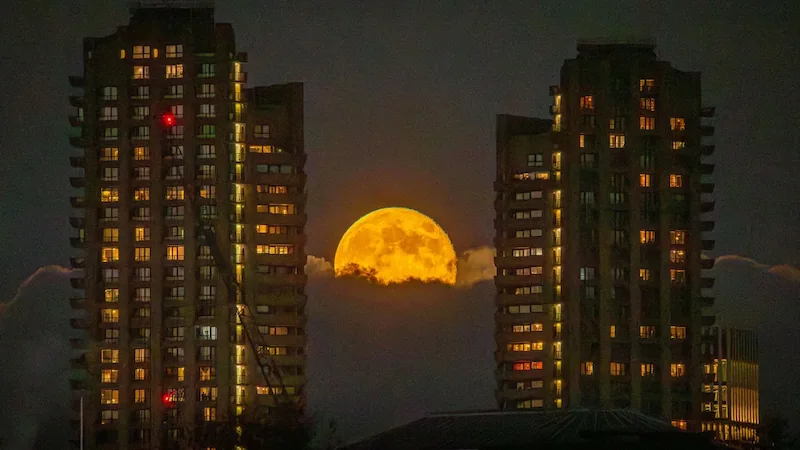


In a celestial display of cosmic wonders, the beaver moon is set to illuminate the night sky this weekend as the last supermoon of the year, captivating sky-gazers with its radiant glow. Named after the beaver’s hibernation habits and thickening coats during this season, the beaver moon will reach its full phase on Friday at 4:29 p.m. ET, painting the heavens with its golden embrace.
However, the moon will appear full a day before and after its peak, providing ample opportunities for viewers to bask in its full splendor. A supermoon occurs when the moon’s closest approach to Earth aligns with its full phase, resulting in a larger and brighter appearance to beholders. This month's supermoon, though slightly farther away than October’s, promises a spectacular sight that beckons the curious observer.
For those eager to witness this celestial phenomenon at its finest, experts recommend observing the moon as it rises above the horizon, a moment that often presents a captivating "moon illusion" where the moon may appear larger than life. While the exact reasons for this illusion remain a mystery, the sheer beauty of the sight is undeniable.
In addition to the earthly observations of the beaver moon, ongoing space missions like NASA’s Lunar Reconnaissance Orbiter continue to deepen our understanding of Earth's faithful companion. These scientific endeavors shed light on the moon’s mysteries, enriching our appreciation of its history and significance in our cosmic neighborhood.
As the beaver moon graces our skies, it brings with it the promise of another celestial spectacle – the Leonid meteor shower. Set to peak on Saturday night into early Sunday, the shower typically produces around 15 meteors per hour, though this year’s display may be dimmed by the luminosity of the full moon. Nevertheless, patient sky-watchers can still catch a glimpse of these shooting stars by facing east and looking half-way up into the night sky.
Even as the Leonids light up the heavens, the upcoming months hold more cosmic delights for avid stargazers. The Geminids meteor shower in December promises a brilliant display on the 12th and 13th, followed by the Ursids shower on the 21st and 22nd. With each celestial event, the night sky offers a breathtaking tapestry of lights, inviting us to gaze upwards and marvel at the wonders of the universe.