


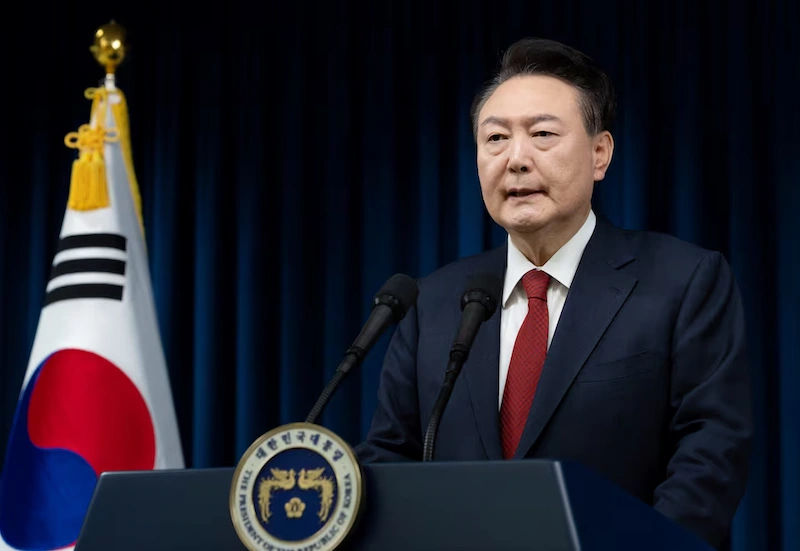


In a stunning turn of events, South Korean President Yoon Suk Yeol has been effectively grounded in his own country, facing a travel ban following a failed attempt at imposing martial law. The justice ministry official revealed on Monday that the president has been restricted from leaving the country, in light of escalating calls for his resignation and a deepening leadership crisis.
While Yoon has publicly apologized for the ill-fated martial law declaration and expressed his willingness to abide by the decisions of his party, the People Power Party (PPP), he has not yet stepped down from his position. Reports from local media indicate that Yoon is now under criminal investigation, casting a shadow of uncertainty over his political future.
The defence ministry confirmed that Yoon still retains his legal status as commander in chief; however, widespread dissent among senior military officials has raised doubts regarding the president's authority. The head of the Corruption Investigation Office for High-ranking Officials, Oh Dong-woon, disclosed that a travel ban had been imposed on Yoon, signaling a significant blow to his ability to engage on an international level.
The chaos stemming from Yoon's decision to grant the military broad emergency powers has sparked internal and external concerns, with senior military figures distancing themselves from the president's actions. A parliamentary committee has been tasked with investigating high-ranking officials, including the president, though it lacks the jurisdiction to prosecute Yoon directly.
As the political turmoil intensifies, the main opposition Democratic Party (DP) has called for Yoon to be stripped of his military authority and demanded the arrest of both the president and any implicated military officials involved in the martial law debacle. Plans are already underway to introduce another impeachment bill in response to the crisis.
Meanwhile, financial markets are being closely monitored for stability, with the finance ministry and regulators gearing up to implement contingency plans to mitigate potential disruptions. South Korea's status as a major global player in memory chip production adds further stakes to the situation, with concerns mounting over the impact of the ongoing turmoil on the economy.
Against this backdrop, the region's geopolitical dynamics have been thrust into the spotlight, particularly in light of North Korea's reported military support for Russia in its conflict with Ukraine. The United States, a key ally with a significant military presence in South Korea, has emphasized the importance of upholding democratic principles and has expressed expectations for a peaceful resolution to the leadership crisis.
Amid these challenges, South Korean officials are striving to rebuild trust with international partners and reassure the global community of their commitment to stability and democratic governance. The future remains uncertain as the country navigates through uncharted waters, grappling with a leadership crisis that has profound implications for its domestic and international standing.