


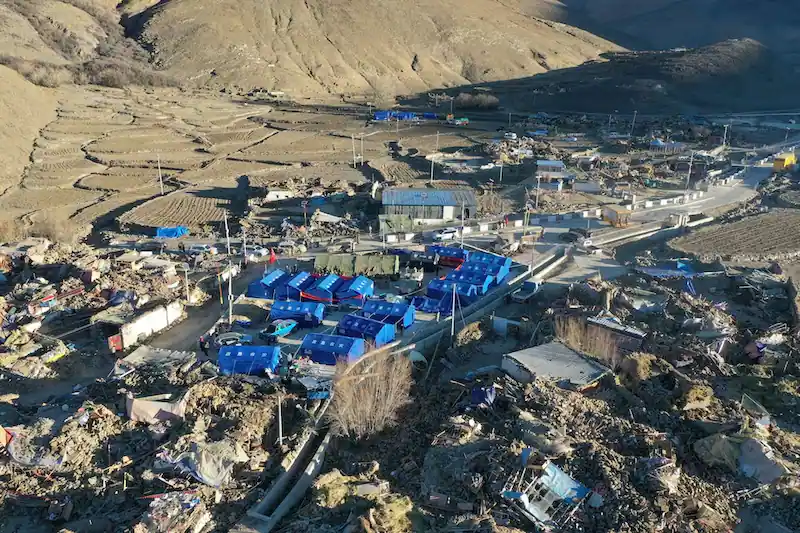


In the aftermath of a powerful earthquake striking Tibet, authorities have mobilized a massive rescue operation, moving over 47,000 individuals to shelters while continuing to search for survivors amidst challenging conditions near the Himalayan foothills. Despite the grim outlook for those trapped under rubble due to plummeting temperatures, officials remain resolute in their efforts to locate any remaining survivors.
While the exact number of missing persons is yet to be determined following the magnitude 6.8 earthquake that claimed 126 lives and left 188 injured, experts believe that those trapped are likely to have succumbed to hypothermia after more than 48 hours. Authorities have affirmed their commitment to sustaining the search and rescue mission, acknowledging the harsh weather conditions including temperatures dropping as low as minus 18 degrees Celsius at night.
A significant part of the rescue operations has been focused on Tingri, the rural county at the quake's epicenter, a region with a population of approximately 60,000 and situated just 80 km north of Mount Everest. The destruction caused by the earthquake includes the collapse of over 3,600 homes in Tingri and the damage to 27,000 more structures, many of which are located at elevations surpassing 4,000 meters.
China swiftly deployed 11,000 rescuers to the affected area immediately after the earthquake struck, with Vice Premier Zhang Guoping taking charge of the relief efforts in the hardest-hit areas. The earthquake, considered one of the region's most potent in recent years, was attributed to a northward compression of the Indian tectonic plate, resulting in a series of tremors and aftershocks that followed.
As the focus shifts towards reconstruction efforts, approximately 47,500 individuals impacted by the earthquake have been relocated to temporary accommodation across 187 sites near the epicenter. The deployment of prefabricated homes, capable of withstanding seismic activity and harsh weather conditions, aims to provide a more secure living environment for those affected.
Amidst the ongoing rescue and recovery endeavors, the Dalai Lama expressed his condolences for the victims of the earthquake and offered prayers for their well-being. Additionally, the Panchen Lama, Gyaltsen Norbu, led a group of monks in prayer at a monastery and made contributions to support the relief operations, underscoring a unified effort to aid those in distress.
While the immediate focus remains on providing aid to those affected by the disaster, Chinese officials have underscored the importance of maintaining social stability and enhancing infrastructure resilience to mitigate the impact of future calamities. The commitment to rebuilding homes and ensuring the well-being of the affected communities stands at the forefront of the ongoing relief efforts in earthquake-stricken Tibet.