


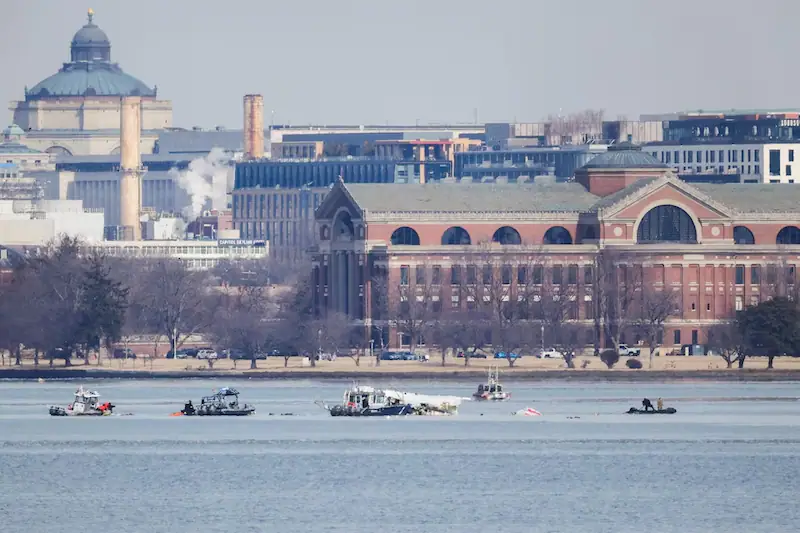


Amidst the aftermath of a tragic midair collision between a passenger jet and a military helicopter that claimed the lives of 67 individuals, including passengers and crew members, federal authorities have made the decision to impose restrictions on helicopter flights near Reagan Washington National Airport indefinitely. The Federal Aviation Administration (FAA) took this action in an effort to mitigate the risk of another potential collision as recovery efforts continue at the site where America's most fatal air disaster in twenty years took place.
The FAA has implemented limitations on most helicopter operations in specific airspaces adjacent to the airport, permitting only police and medical helicopters to operate in the vicinity between the airport and nearby bridges until a comprehensive evaluation is conducted. The duration of these restrictions remains uncertain, pending further assessments.
The recent crash has brought to light critical concerns regarding air safety and the shortage of tower controllers at Reagan National Airport, a critical transportation hub serving the U.S. capital. The Washington region's airspace is notably congested, accommodating multiple commercial airports, military installations, and frequent helicopter flights transporting government officials. An analysis by the Government Accountability Office revealed that over a three-year period, there were approximately 88,000 helicopter flights within a 30-mile radius of Reagan National Airport, including military and law enforcement operations.
The unfortunate incident involved an American Airlines passenger plane attempting to land at Reagan National Airport, colliding with an Army Black Hawk helicopter before plunging into the Potomac River. Divers are now focusing on salvaging both aircraft and retrieving essential components from the wreckage. While investigations are ongoing, officials have yet to determine the exact cause of the collision, underscoring the pressing need for enhanced air safety protocols.
The National Transportation Safety Board (NTSB) is actively working to recover the helicopter's black box, crucial for deciphering flight data and cockpit communications. At the same time, questions surface surrounding the staffing levels at the FAA, with a significant shortage of controllers affecting operational efficiency. Transportation Secretary Sean Duffy has committed to restructuring the FAA to bolster safety measures and operational oversight.
Amidst heightened scrutiny, President Donald Trump attributed the collision to the military helicopter flying above the designated altitude limit, emphasizing the need for adherence to safety regulations. Senator Maria Cantwell has raised concerns about the proximity of military and commercial flights and urged a reassessment of the volume of helicopter operations in such a congested airspace.
As investigations progress and recovery efforts unfold, the aviation community grapples with the implications of this tragedy, emphasizing the critical importance of stringent safety protocols and enhanced communication mechanisms to prevent such catastrophic incidents in the future.