


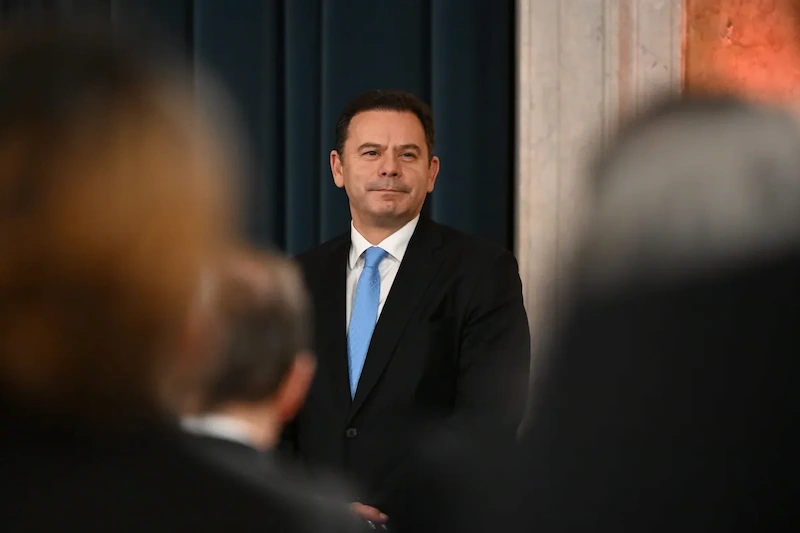


Portuguese Prime Minister Luis Montenegro is facing increasing scrutiny over potential conflicts of interest related to a family-owned company, as his minority government continues to navigate challenges less than a year into its term.
In response to mounting speculation, Montenegro has scheduled a national address for 8 p.m. on Saturday in Lisbon, where he plans to announce "personal and political decisions" aimed at ensuring the government's focus remains on serving the country. Prior to this, an extraordinary cabinet meeting will be held at 6 p.m.
The questions surrounding the family-owned company have placed additional pressure on Montenegro, who heads a government reliant on support from opposition parties in parliament. Last month, the prime minister faced a censure motion from the far-right party Chega, which demanded clarification regarding the firm to dispel any suspicions of a conflict of interest.
Montenegro has defended his ownership stake in the company, Spinumviva, emphasizing that it was established during a period when he was not involved in politics. He has dismissed claims that his ties to the firm create a conflict of interest, stating that he has not made any decisions that compromise his political duties.
Reports reveal that Spinumviva has been receiving monthly payments of €4,500 from Solverde, a Portuguese casino and hotel operator, since July 2021, for services related to compliance and personal data protection.
The prime minister, a former lawyer, has pledged to recuse himself from any government decisions involving companies connected to him. Notably, upcoming decisions regarding casino concessions in Algarve and Espinho, currently held by Solverde and set to expire in 2025, may pose significant challenges for the government.
Montenegro, who assumed office in April, has been navigating a challenging political landscape, requiring concessions and compromises to secure approval for key policies, such as tax reforms. Plans for the privatization of the state-owned airline TAP SA are among the government's top priorities for the year.
The ruling AD coalition, led by Montenegro's center-right PSD party, narrowly defeated the Socialists in an early election held in March the previous year. This followed the unexpected resignation of former Prime Minister Antonio Costa amidst allegations of influence peddling. Costa, currently serving as the European Council president, has refuted any wrongdoing.
Since the Carnation Revolution 50 years ago, which marked the end of a decades-long dictatorship, Portuguese politics have been dominated by the Socialists and PSD. Despite this, minority governments in Portugal have historically faced challenges in maintaining stability, with only two administrations completing a full term in the past five decades.
Economic stability and fiscal discipline continue to be key priorities for Portugal, particularly in the aftermath of the euro-area debt crisis and subsequent bailout. Despite a decrease in the debt-to-GDP ratio in 2023, the country remains vigilant about managing its high levels of debt.
Montenegro's government is striving to achieve a budget surplus of 0.3% of GDP this year, as economic growth shows signs of acceleration. The Bank of Portugal recently revised its growth forecast for 2025 upward to 2.2%.
In response to these developments, S&P Global Ratings upgraded Portugal's government bond rating to A from A-, citing positive deleveraging trends. As the government navigates these challenges, financial markets have shown a relatively stable response, with Portugal's bond yields remaining steady.