


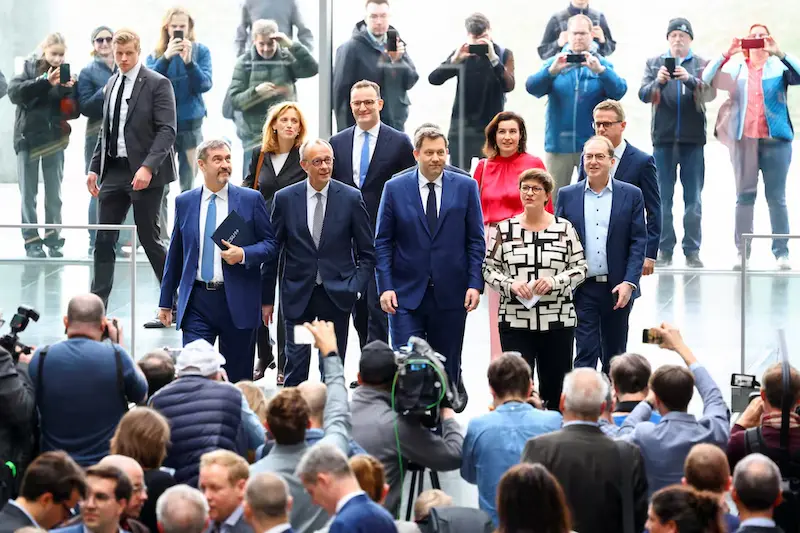


In a significant move to address economic challenges amid escalating global trade tensions, German conservatives led by Friedrich Merz signed a coalition agreement with the centre-left Social Democrats on Wednesday. The agreement comes at a critical juncture as the world economy faces uncertainty due to a trade war initiated by U.S. President Donald Trump's imposition of import tariffs.
Merz, the impending chancellor, emphasized the importance of reviving Germany's economic growth and competitiveness, sending a message in English directly to the White House: "Germany is back on track." The coalition pact aims to provide a robust and proactive government capable of navigating the current turbulent global economic landscape.
Key elements of the agreement include tax cuts for middle and lower incomes, reductions in corporate taxes, support for the electric car industry, and the removal of a contentious supply chain law. Additionally, the coalition plans to initiate reforms to Germany's constitutionally mandated spending limits to foster economic growth effectively.
Amid the increasing pressure from the far-right Alternative for Germany party, the coalition outlined a stricter stance on migration, proposing measures such as turning away asylum seekers at borders and discontinuing fast-tracked naturalization. Furthermore, plans for a voluntary military service and the establishment of a national security council were announced, alongside efforts to streamline defense procurement processes and support Ukraine's NATO aspirations.
On the economic front, the coalition intends to pursue a free trade deal with the United States in the medium term while also advocating for a unified EU response to the global tariff confrontation. The implementation of infrastructure investments was emphasized as critical to mitigate the potential impact of trade disruptions and prevent a prolonged economic downturn.
Despite the challenges ahead, this coalition agreement aims to set Germany on a path towards economic revitalization and strengthened global partnerships, signaling a shift towards a proactive and decisive government approach in the face of complex geopolitical and economic circumstances.