


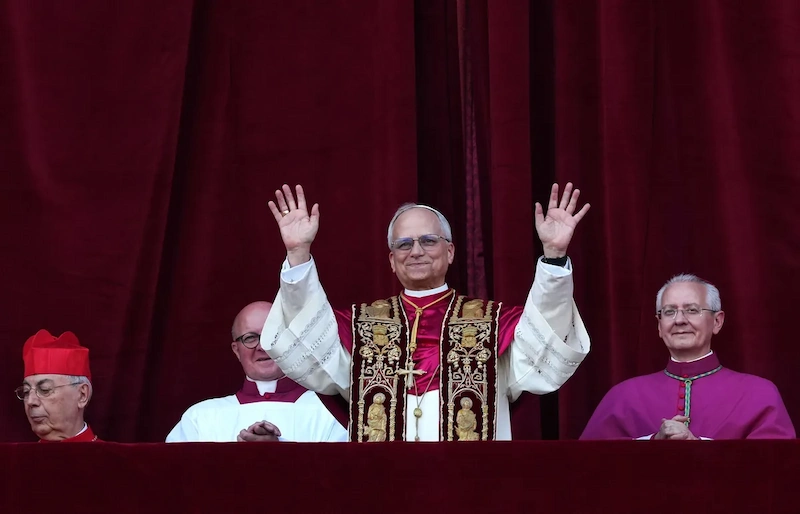


In a historic moment, Cardinal Robert Francis Prevost made history by becoming the first-ever pope from the United States. Taking on the name Leo XIV for his papacy, he emerged as a potential unifying figure in a Church divided between progressives and conservatives.
Stepping out onto the balcony overlooking St. Peter’s Square, the 69-year-old pontiff was met with a wave of jubilant cheers and applause from the crowd of faithful. With a message of peace, Pope Leo XIV extended his blessings to the gathered throngs.
Succeeding the late Pope Francis, Pope Leo inherits a Church grappling with internal discord over contentious issues such as divorce and LGBTQ+ rights. With geopolitical tensions simmering worldwide, he faces the daunting task of navigating tumultuous global landscapes, from the war in Ukraine to conflicts in the Middle East.
The swift consensus reached among the Church’s electors, many of whom were appointed by his predecessor, Pope Francis, hints at a seamless transition. Pope Francis' influence on the selection process is evident, having previously entrusted Cardinal Prevost with key roles in the Roman Curia.
In his inaugural address, the new pontiff urged for unity and dialogue, emphasizing the power of collective strength in overcoming adversity. The choice to deliver his message in Spanish and Italian underscores his inclusivity and international appeal.
Pope Leo XIV's background in the Order of St. Augustine reflects his commitment to theological scholarship and social justice. Drawing inspiration from influential predecessors such as Leo XIII, known for his progressive stance, he signals a desire to propel the Church forward while honoring its rich traditions.
Across the Atlantic, US President Donald Trump expressed excitement at the prospect of meeting the new pontiff, highlighting the significance of this historic moment. Pope Leo XIV's intellectual prowess and dedication to social justice bode well for forging strong ties with world leaders.
Embracing humility and service, Pope Leo XIV follows his predecessor's example by eschewing the trappings of his office. His governance skills honed in Peru and Rome, coupled with multilingual abilities, mark him as a thoughtful and progressive leader poised to guide the Church in an ever-changing world.
As the successor to a transformative pope, Pope Leo XIV stands at a pivotal juncture in the Church's history. With his vision of unity and dialogue, he sets out to bridge the rifts within Catholicism and lead the faithful towards a brighter future.