


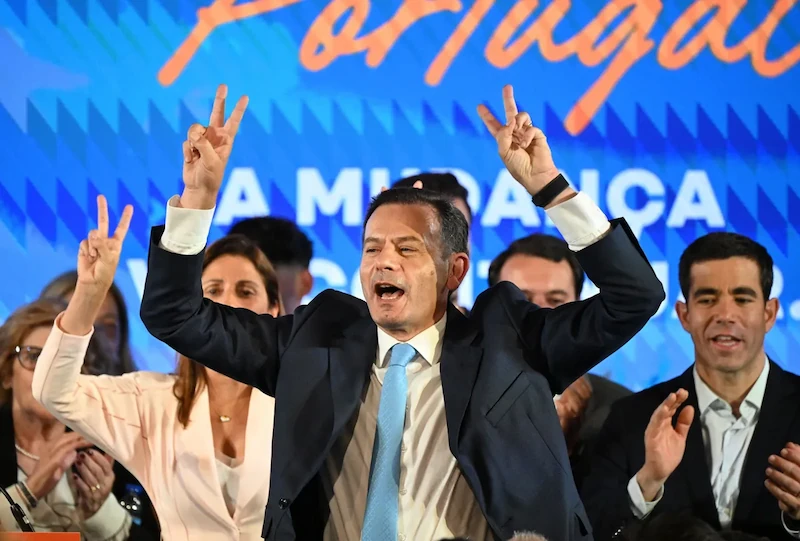


In a surprise turn of events, Portugal witnessed a significant shift in its political landscape as the ruling center-right coalition managed to retain power in a snap election, despite facing challenges from the surging far-right movement. Prime Minister Luis Montenegro's coalition secured nearly 33% of the vote, strengthening its position in parliament to at least 89 seats, marking a notable improvement over the previous election results.
However, all eyes were on the far-right Chega party, as early results hinted at the possibility of it surpassing the Socialist Party to become the second-largest group in parliament. The deadlock between the two parties with 58 seats each, representing 23% of the vote, highlighted the growing disillusionment with traditional center-left and center-right politics among the Portuguese electorate.
The prospect of Chega emerging as the main opposition party signifies a historic moment, breaking the decades-long dominance of the conventional political forces in Portugal. This unprecedented scenario underscores the evolving dynamics of the country's political landscape, reflecting a broader trend seen in neighboring countries like Romania and Poland where populist right-wing movements gained momentum in recent elections.
While the center-right coalition under Montenegro's leadership is set to form a minority government, the need for cross-party cooperation to pass legislation poses challenges in fulfilling ambitious policy agendas. Despite Chega's ascent, formal alliances with the far-right remain off the table, given its hardline anti-immigrant stance.
The election results also signaled a setback for the Socialist Party, prompting the resignation of its leader Pedro Nuno Santos. As Montenegro aims to push forward with plans to lower taxes, increase the minimum wage, and address key socio-economic issues, the support of other political factions becomes essential for policy implementation.
The outcome of the election reflects a historical loss for the left, underscoring the redefined political landscape in Portugal. With pressure mounting on parties to navigate the political instability and ensure a sustainable government, the path ahead remains uncertain, with the need for cohesion among divergent ideologies to drive progress in governance.
As Portugal enters a new phase of political evolution, the resilience of traditional center-right policies coupled with the rise of the far-right marks a pivotal moment in the country's democratic journey. The upcoming decisions on key appointments and policy priorities will shape the trajectory of the government, highlighting the delicate balance between political forces in the quest for stability and progress.