


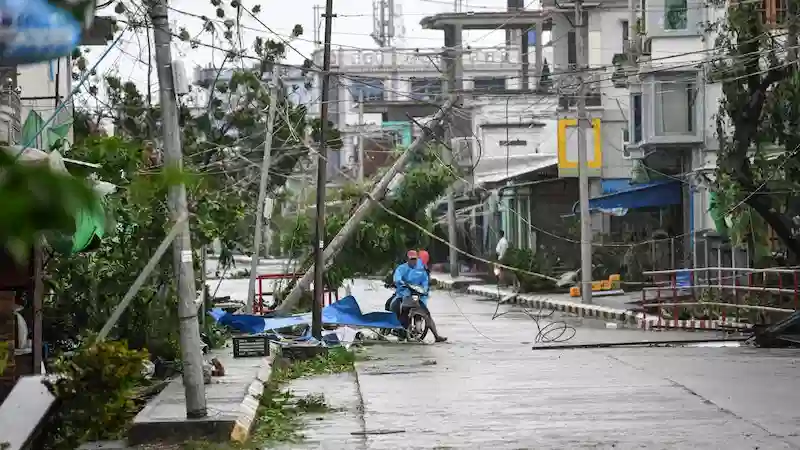


Cyclone Mocha has caused significant damage in western Myanmar after making landfall on Sunday. With wind speeds of over 200 km/h, the cyclone has blown off roofs of buildings, uprooted trees and brought down power lines. According to The Irrawaddy, a local news organization, a telecommunications tower was left crumpled as well. Although the cyclone is rapidly weakening, it is still bringing strong winds and heavy rain to the country. Mocha is expected to dissipate over northern Myanmar by Tuesday morning.
The United Nations has reported that "most" people in the city of Sittwe have evacuated to smaller regional villages or taken shelter in Sittwe’s monasteries. The region is home to hundreds of thousands of people who have been displaced by fighting. There is particular concern for the one million Rohingya and other Muslim minorities from Myanmar who live in refugee camps outside of Cox's Bazar, Bangladesh. The Bangladesh Meteorological Department said that the cyclone is likely to move north-northeasterly across Rakhine State in Myanmar and "completely cross" Cox’s Bazar.
Aid agencies in Bangladesh and Myanmar have launched a massive emergency plan as the storm brings the threat of flooding and landslides. Disaster response teams, along with more than 3,000 trained local volunteers, have been put on standby in the camps. A national cyclone early warning system is also in place, according to Sanjeev Kafley, Head of Delegation of the IFRC Bangladesh Delegation. About one million members of the stateless Rohingya community, who fled persecution in Myanmar during a military crackdown in 2017, are living in the sprawling and overcrowded camps in Cox's Bazar. Most live in bamboo and tarpaulin shelters that are vulnerable to strong winds, rain, and landslides.
There are also concerns for 30,000 Rohingya refugees housed on an isolated and flood-prone island facility in the Bay of Bengal called Bhasan Char. The UN refugee agency has reported that volunteers and medical teams are on standby and cyclone shelters and food provisions are available for those living on the island.
The past few decades have seen an increase in the strength of tropical cyclones affecting countries in parts of Asia, and recent research predicts that they could have double the destructive power in the region by the end of the century. While scientists are still trying to understand ways climate change is affecting cyclones, a slew of research has linked human-caused global warming to more potent and destructive cyclones. Bangladesh and Myanmar are particularly threatened because they are low-lying and home to some of the world’s poorest people.