


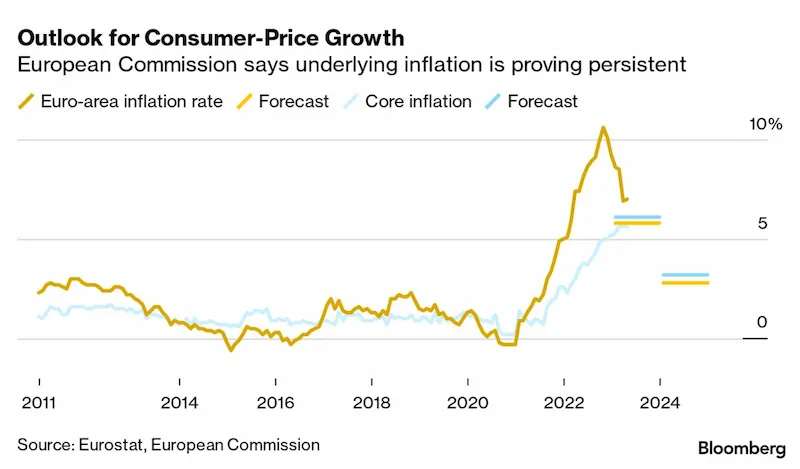


The European Commission has increased its inflation outlook for the Eurozone and warned of ongoing challenges despite acknowledging the resilience of the region's economy. The officials from the European Union raised their projections for consumer-price growth to 5.8% this year and 2.8% in 2024, which is up from 5.6% and 2.5%, respectively. The forecasts for economic expansion were also increased across the horizon. This rise in inflation brings a challenge for European Central Bank policymakers who have raised benchmark borrowing costs by 375 basis points to tame inflation.
The EU officials have also increased the projection for core inflation, which strips out volatile elements such as food. This measure is expected to exceed the headline gauge for price growth both this year and next. Despite the gradual decline in core inflation as profit margins absorb higher wages and tighter financing conditions, there are still persistently high price pressures in services. These coupled with slowly fading pressures in processed food and goods are expected to keep core inflation elevated.
The EU's forecast for headline price growth this year is now half a percentage point higher than the ECB outlook released in March. For next year, it is only 0.1 percentage point lower. The projections are more optimistic on growth than previous outlooks from the commission. The EU Commissioner for Economy, Paolo Gentiloni, stated that "thanks to determined efforts to strengthen our energy security, a remarkably resilient labour market and easing supply constraints, we avoided a winter recession and are set for moderate growth."
The gross domestic product (GDP) of the region is expected to rise 1.1% this year and 1.6% in 2024, which is marginally higher than before. No recession is envisaged in any euro-area country throughout the horizon. The only annual contraction in the Eurozone will occur in Estonia in 2023 with a drop of 0.4%. The only other contraction in the EU as a whole will be Sweden's 0.5% decline. However, this outcome is better than previously forecast, though it incorporates a 1.1% slump during the current quarter.
Despite the improved growth outlook, Gentiloni warned that risks remain too plentiful for comfort, and Russia's invasion of Ukraine continues to cast a shadow of uncertainty over the outlook. The Eurozone only grew 0.1% in the first quarter, and industrial production data for March help explain why: the gauge slumped by 4.1% from the previous month. This is the most significant decline since April 2020, when the pandemic shuttered factories across the advanced world.