


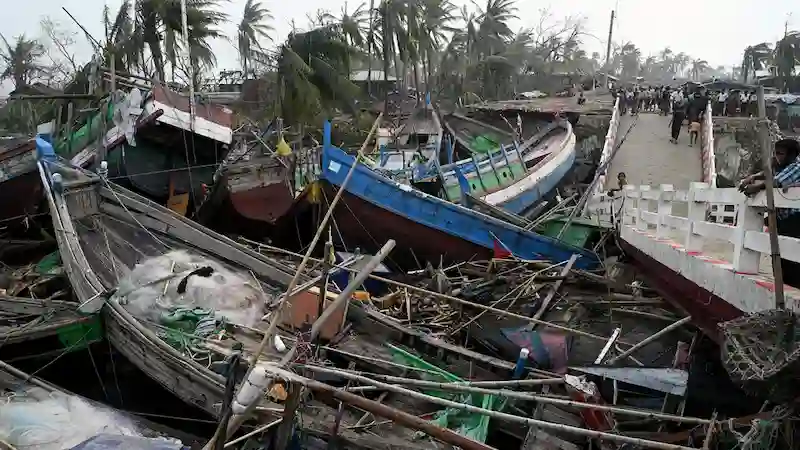


Cyclone Mocha, one of the strongest storms to ever hit Myanmar, has devastated the country's west coast, causing severe damage to houses and uprooting trees. Aid agencies have warned of the possibility of "a large-scale loss of life" in the country, particularly in the conflict-ridden Rakhine state, where hundreds of thousands of displaced people live in poorly constructed camps. Nearly a million Rohingya members of the persecuted Muslim minority group have already fled Myanmar since 2017 due to a brutal crackdown by the country's junta. A large proportion of Rohingya refugees remain in Rakhine, where aid agencies fear they have been hit hardest by the cyclone. According to Brad Hazlett, the president of the NGO Partners Relief and Development, at least one village that they have connected with has been totally destroyed, and over 20 people have lost their lives there. The death toll in Rakhine is currently at 41, but aid agencies expect the number of casualties to rise as phone networks remain unstable, roads are blocked, and many people remain missing or may be trapped under destroyed shelters.
The cyclone has also destroyed about 90% of the shelters at a Rohingya refugee camp near Sittwe, as observed by resident Aung Zaw Hein. He reported that people have become homeless, shelterless, and powerless, with no food or place to lie down. Hein saw the bodies of children, elderly, and pregnant women lying on the ground after the cyclone and performed Islamic funeral prayers for eight victims. Military-owned Myawaddy TV, however, has reported that the official death toll stands at three people, with 13 others injured.
About 6 million people in the region were already in need of humanitarian assistance when the UN's humanitarian office (OCHA) warned of the approaching cyclone. Among them were 1.2 million people who were internally displaced by ethnic conflict. Myanmar's military, which seized power in a 2022 coup, view the Rohingya as illegal immigrants from Bangladesh, while the Rohingya counter that they have lived in Rakhine for generations. Human Rights Watch estimates that about 600,000 Rohingya remain in Rakhine, "subject to government persecution and violence, confined to camps and villages without freedom of movement, and cut off from access to adequate food, health care, education, and livelihoods."
Cyclone Mocha spared the world's largest refugee camp in Bangladesh a direct hit, but the storm has caused significant damage to Myanmar's west coast. The last storm to make landfall in Myanmar with similar strength was Cyclone Giri in October 2010, which caused over 150 fatalities and destroyed roughly 70% of the city of Kyaukphyu. The UN reported that about 15,000 homes were destroyed in Rakhine state during that storm. Cyclone Nargis, which hit Myanmar's low-lying Irrawaddy Delta in 2008, killed nearly 140,000 people and caused widespread destruction.