


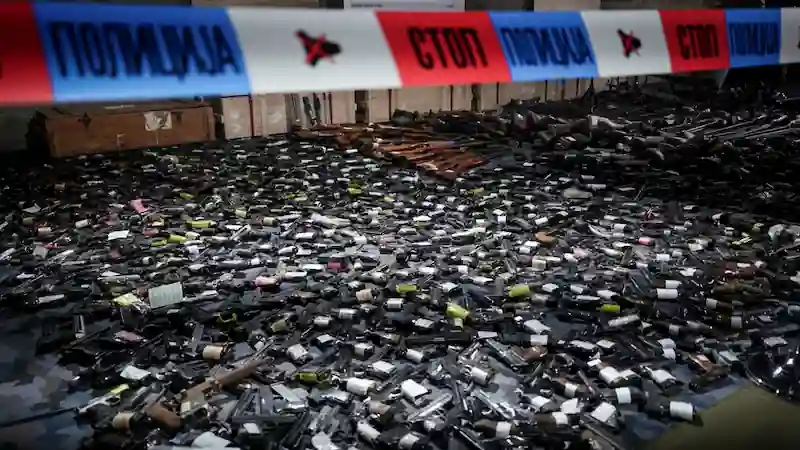


Serbia recently experienced a tragic event where 18 people were killed and 21 injured in two consecutive mass shootings. In response to these events, the President of Serbia, Aleksandr Vučić, announced an ambitious gun amnesty program aimed at the "almost total disarmament" of the country. However, this policy has not been viewed as sufficient reassurance by the people of Serbia, who are calling for more than disarmament to end violence.
The anger of the people is directed at the "culture of violence" that has been prevailing in the country, from iron-fisted political discourse to the exaltation of criminals. The government's response to these issues has been criticized for being insufficient, and the people are calling for a mellowing of the political culture.
Serbia has one of the highest rates of gun ownership in the world, but mass shootings like the recent ones are extremely rare in the country. The country ranks third in the world for gun ownership per capita, with an estimated 2.7 million guns, but fewer than half of these are registered with the government.
While the amnesty program has drawn praise from abroad, some domestic observers have criticized the president's offensive language, an unacceptable tone, and vocabulary that was devoid of any compassion and desire to achieve catharsis after these violent events.
Public anger has also been directed at television shows and their violent content. The most popular reality show on the pro-government Pink TV is hosted by a convicted murderer and drug trafficker. Nearly 440,000 people have signed a petition calling for two pro-government TV stations to lose their licenses for broadcasting violent reality shows.
In response to these events, tens of thousands of Serbians have taken to the streets in opposition-led "Serbia against violence" marches, demanding the resignation of several government ministers. The education minister has already stepped down, and the interior minister is under intense pressure to do the same.
Despite the president's hard talk, the protests have already softened some of Belgrade's tough exteriors. A mural of a convicted war criminal, Ratko Mladic, has long stood proudly on one of the city's walls, but this time, it has been erased entirely, replaced with the message: "Turn on your brain. Turn off Pink TV."
In conclusion, the recent events in Serbia have brought to light the underlying culture of violence prevalent in the country. While the gun amnesty program is a step in the right direction, the people of Serbia are calling for a mellowing of the political culture and an end to the glorification of criminals.