


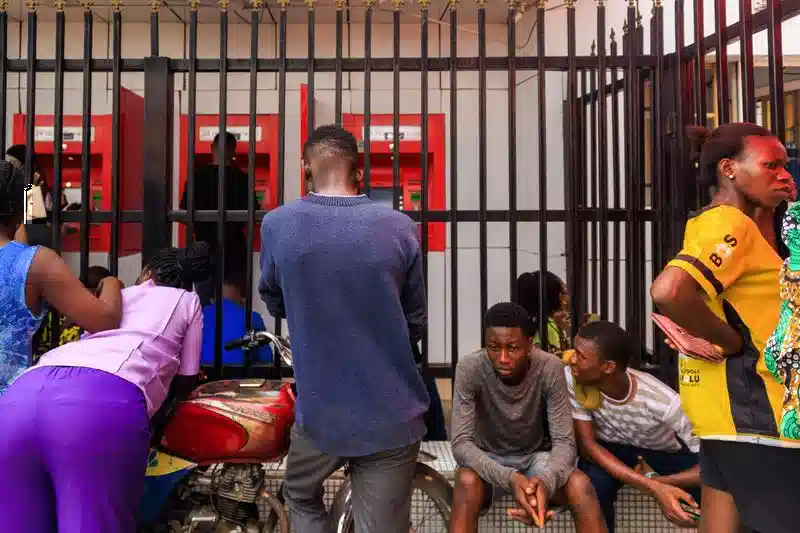


To alleviate the cash shortage that has been disrupting individual and business transactions and impeding the cash-based economy in Nigeria since January, the country's central bank has increased the supply of banknotes to lenders. This move has prompted many banks, including United Bank for Africa Plc, Zenith Bank Plc, and FBN Holdings Plc, to call in staff on weekends to assist customers in accessing cash at banks or via ATMs. The distribution of banknotes, which is being conducted in accordance with a central bank directive, is personally overseen by Governor Godwin Emefiele, according to spokesman Isa Abdulmumin. Residents are expected to have unrestricted access to cash within the weekly withdrawal limits. Late last year, Africa's most populous nation experienced a cash shortage after the central bank began replacing old 200-, 500-, and 1,000-naira notes with new ones in an effort to reduce excess liquidity, promote electronic payments, and control inflation. Some state governors contested the program in court, and the Supreme Court extended the February 10 deadline for phasing out old notes until the end of the year.
Despite the court's order for the central bank to redistribute old notes worth 2.2 trillion naira, or 70% of the cash in circulation, to ease the shortage, residents in Nigeria have still been struggling to access banknotes. As of last week, few banks and ATMs had supplies, prompting the Nigerian Labour Congress, the umbrella workers union, to plan protests at central bank offices from March 30. However, the improved distribution of banknotes is expected to balance the supply and demand for cash in the economy, thus preventing further obstacles to personal and business transactions. In Nigeria's informal economy, about 90% of transactions are conducted using cash.
While the cash supply is being improved, the central bank will maintain the weekly withdrawal limits of 500,000 naira and 5 million naira for individuals and companies, respectively, to discourage residents from holding excess money, according to spokesman Isa Abdulmumin. The central bank's cashless rule also imposes a processing fee of 3% for individuals and 5% for companies seeking to withdraw cash above the limits.