


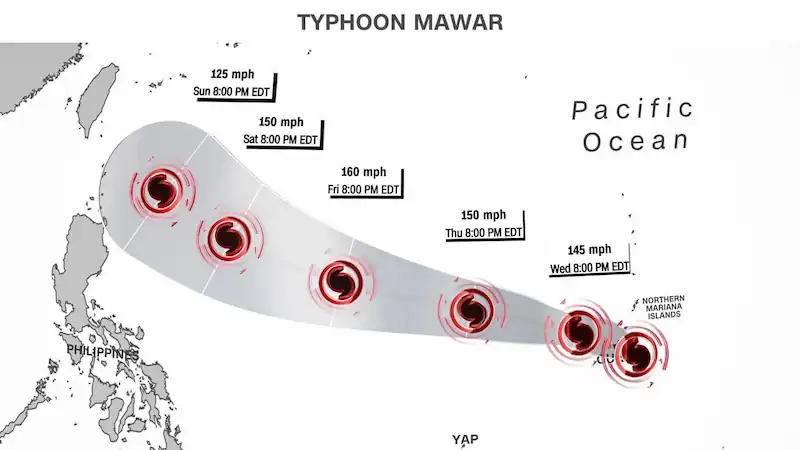


Typhoon Mawar, the strongest storm to hit Guam in decades, has brought destructive winds and torrential rain to the US territory. Although the eye of the storm passed just north of Guam, the powerful winds and rain from its eyewall have pelted the entire 30-mile-wide island, causing widespread power outages. In anticipation of the storm surge and potentially catastrophic coastal flooding, Guam's Governor mandated the evacuation of low-lying coastal areas.
The Guam International Airport recorded sustained winds of 71 mph with a gust of 105 mph, and an extreme wind warning was issued for the northern part of Guam, where tornado-like damage could occur. The weather service in Guam warned residents to treat the imminent extreme winds as if a tornado was approaching and to move immediately to an interior room or shelter.
The slow forward pace of Typhoon Mawar, about 8 mph, could exacerbate the impacts of wind and bring greater amounts of rainfall to the island. The storm is threatened to bring between 15 to 20 inches of rain, which could trigger landslides, overflow rivers and streams, and bring flooding to areas that don't normally experience such events. While the storm surge is expected to be lower than initially feared, ocean levels 4 to 6 feet above normal high tides are still possible, and maximum observed wave heights over the ocean have reached up to 40 feet.
Scientists have warned that human-caused climate change is contributing to an upward trend of intense storms like Typhoon Mawar. These systems generate more rainfall, larger storm surge, and are more likely to be stronger, and to intensify faster, leading to more deadly storms. The rapid intensification of tropical cyclones is more likely as ocean temperatures climb and create the groundwork for cyclones to explode at breakneck pace.
The storm has caused extensive damage to infrastructure and landscapes, with extensive roof and structure damage being possible due to the pummeling winds. The local weather service has warned that electricity and water may be unavailable for days or weeks, and most trees will be snapped or uprooted. Between 50 to 70 percent of Guam’s vegetation could experience defoliation. Although Guam sits in an area of the West Pacific Ocean that is prone to the world’s strongest tropical cyclones, it is extremely rare for the island to be struck directly by a storm of this strength.