


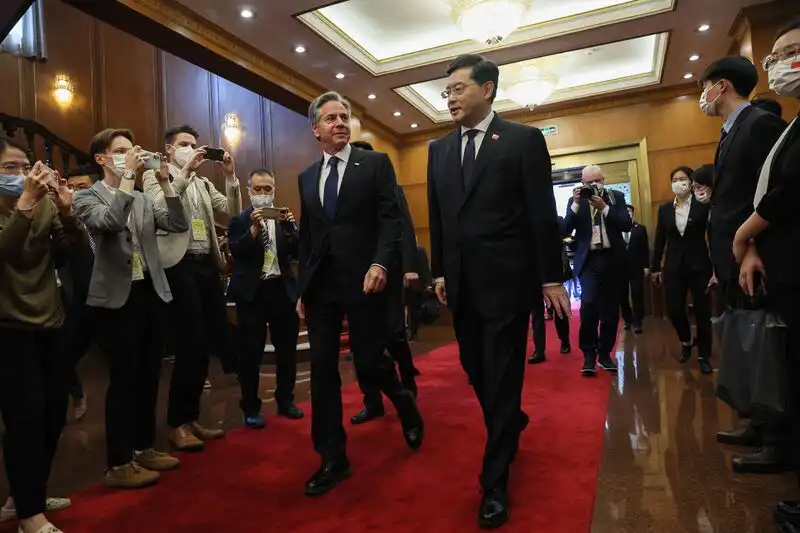


US Secretary of State Antony Blinken had what the State Department called "candid, substantive, and constructive" talks with his Chinese counterpart during his visit to Beijing. The meeting between Blinken and Foreign Minister Qin Gang lasted more than five hours, longer than initially planned. In a sign of improving relations, Qin has accepted Blinken's invitation to visit Washington at a mutually convenient time. The US readout of the meeting said that Blinken raised several issues of concern, but did not provide details.
Blinken's trip to China comes at a time of strained relations between the two superpowers, with disagreements ranging from human rights and technology to trade and weapons sales to Taiwan. While senior US officials have downplayed expectations of any significant breakthrough or resolution of fundamental disagreements, the main goal of Blinken's trip is to re-establish senior-level channels of communication with Chinese counterparts. This includes channels between their militaries, in order to manage the fierce competition between the two countries.
Before his departure from Washington, Blinken stated that his primary objectives are to build stronger channels of communication, express US concerns frankly about Chinese policies, and to urge cooperation on global issues, such as macroeconomic stability and climate change. Despite the fact that some of the engagements between the US and China have been in public, it is believed that others have been out of the limelight. For example, White House National Security Adviser Jake Sullivan has been meeting with his Chinese counterpart for low-key gatherings in Vienna. CIA Director Bill Burns also recently visited Beijing for a secret visit, where he discussed intelligence issues.
Although the interactions between US and China have shown a gradual pick-up of momentum, the two countries' relations are still subject to instability. In the past, there have been incidents relating to Taiwan that could again bring relations down. The senior State Department official in Tokyo has stated that both US and China are aware of the state of their bilateral relations, and recognize that senior-level interactions are necessary to help stabilise the relationship.
As Jessica Chen Weiss, a professor of China and Asia-Pacific studies at Cornell University, described it, "A good outcome would be a better understanding of each side's concerns and red lines as well as modest progress on areas of overlapping interest. Ultimately, one hopes that the two sides can make progress in the next several months toward a principled framework to manage US-China relations, one backed by small but credible signs of a shared interest in stabilising the relationship."