


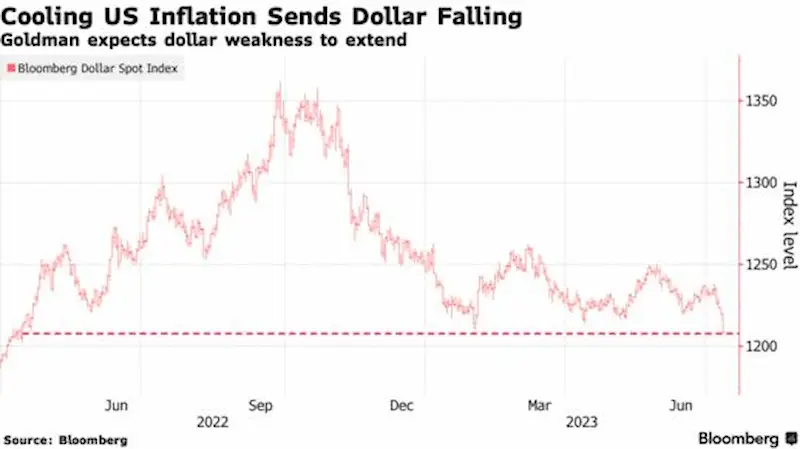


Goldman Sachs Group Inc. has joined the growing group of dollar pessimists following Wednesday's significant inflation report. The investment bank predicts that the US dollar will continue to decline at a moderate pace, which will benefit currencies that have been under pressure from the Federal Reserve's aggressive policy tightening. These currencies include those from emerging markets, as well as the Swedish krona and the Japanese yen.
In a note to clients on Thursday, Goldman analysts Michael Cahill, Isabella Rosenberg, and Teresa Alves commented on the recent sell-off of the dollar, attributing it to cooler inflation and expectations of a more patient approach to interest rate hikes by the Federal Reserve after July. They believe that this trend will persist, as the factors that influenced the inflation report will likely remain soft in the coming months.
This week, data revealed a significant slowdown in US price pressures, casting doubt on the possibility of further interest rate increases. As a result, the Bloomberg Dollar Spot Index dropped nearly 1% on Wednesday, reaching its lowest level since April last year. This downward movement is continuing in Thursday's trading session. The impact of the weakening US dollar is also being felt in global currency markets, with the Swiss franc rallying to its strongest level since 2015, and the euro and British pound rising to their highest levels in over a year.
However, it is important to note that while the dollar has weakened by about 5% in the two months since reaching its peak in September, inflation pressures remain elevated. This indicates that there are still risks associated with the "fade-the-dollar" trade strategy.
Goldman analysts emphasize that they expect the depreciation of the US dollar to be less drastic and more gradual compared to previous periods. Nonetheless, they highlight that certain Group-of-10 currencies, such as the British pound and the Norwegian krone, which still face inflation challenges, should perform well in this environment.
In Thursday's trading, the Swedish krona was the best-performing currency among the Group-of-10, gaining 1.7% against the US dollar. The Japanese yen also gained 0.3% against the greenback. Goldman identifies the British pound and the Norwegian krone as currencies that are likely to benefit from the more tempered upside risks for the dollar.
As of Thursday, the Norwegian krone rose 1.2%, and the British pound added 0.9% against the US dollar in New York trading.