


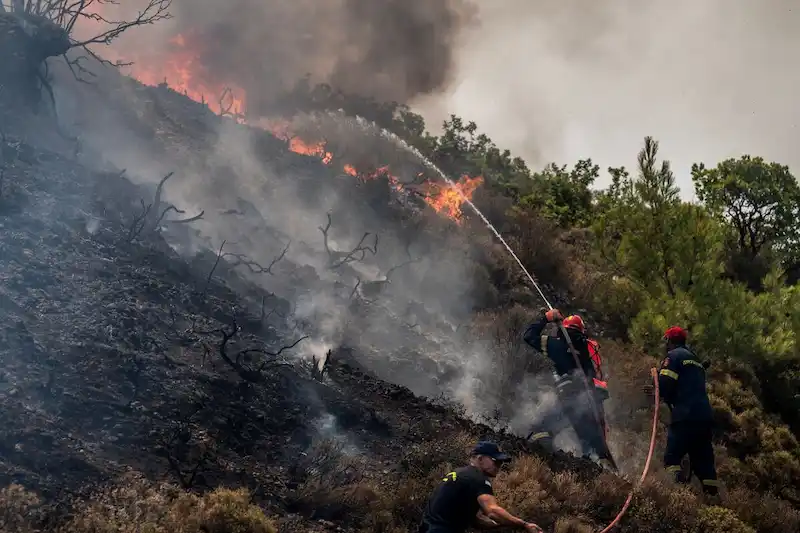


As Greece continues to grapple with a scorching heatwave, authorities are taking urgent measures to evacuate parts of the central city of Lamia. High winds and soaring temperatures have intensified the threat posed by wildfires across the country, prompting residents in the northern region of Lamia to relocate to safer areas. With temperatures reaching a staggering 47C (116.6F), the situation on the islands of Rhodes and Corfu has also deteriorated, leading to further evacuations as coastguard vessels stand by for possible beach rescues.
While other parts of the Mediterranean have experienced a slight cool down, Greek firefighters are battling against a staggering 146 wildfires. The highest risk has now shifted to the Greek mainland, particularly in the vicinity of Athens. The situation on the island of Evia, where two pilots tragically lost their lives while trying to extinguish the flames, has improved slightly. Nevertheless, extreme temperatures across the Northern Hemisphere are sounding alarm bells about the rapid pace of climate change. Even in the southernmost parts of the globe, such as Antarctica, sea ice is struggling to regenerate after hitting a record low in February.
Scientists assert that the unprecedented heatwaves witnessed in Europe and North America would have been "virtually impossible" without the influence of climate change. Despite these warnings, many leaders continue to resist efforts to curtail the use of fossil fuels, which contribute to greenhouse gas emissions and global warming. While southern Europe is experiencing temporary respite from the scorching heat, temperatures are expected to rise again in Spain by the end of next week. In the meantime, Greece has endured yet another challenging day, prompting the Greek Labour Minister to prohibit outdoor work in areas where the temperature reaches or surpasses 40C (104F) from midday to 5 p.m. Delivery services that violate these rules may face substantial fines. Additionally, tourist attractions like the Acropolis in Athens have had to limit their opening hours, closing their doors to visitors at 11 a.m. but reopening at 5:30 p.m. On a positive note, temperatures across Greece are projected to decrease by up to 8C, starting from Thursday.
Nevertheless, the risk of wildfires remains significant. Tomorrow, seven out of Greece's 13 regions will be on the highest level of fire alert, compared to the five regions on alert on Wednesday. Strong winds with speeds of up to 61 kilometers per hour (38 miles per hour) are predicted, elevating the danger. Thessaloniki, Greece's second-largest city, and its surrounding areas, typically cooler than Athens, are among the locations at maximum risk. To aid in firefighting efforts, nearly 500 firefighters and seven aircraft have been dispatched by European Union nations.
The emissions from the wildfires in Greece throughout July were the highest in the past two decades, according to the Copernicus Atmosphere Monitoring Service. Over the past week alone, more than 35,000 hectares of forest have been engulfed in flames across the country, causing significant damage to wildlife and threatening the livelihoods of locals who rely on summer tourism. Strong winds are impeding firefighting operations across the Mediterranean, from Algeria to Turkey, following the record-breaking heat experienced this month.
Italy, on the other hand, is expected to experience a slight cooling in the coming days. After hitting a high of 48C on Monday (just below the European record of 48.8C set in Sicily two years ago), Sardinia is forecasted to stay below 40C until Friday.
In some areas, the extreme heat has been accompanied by violent storms, including destructive hailstorms. On Monday, the European record for the largest hailstone was broken when a stone with a diameter of 19 centimeters was confirmed in northern Italy, as documented in the European Severe Weather Database. This was just shy of the world record of 20.3 centimeters set in South Dakota back in 2010.
Although northern Europe has been experiencing cooler weather, that trend is gradually shifting southwards. The Mediterranean is anticipated to return to more seasonal temperatures in the coming days. However, countries such as the UK, Germany, France, and the Nordic regions will continue to have cooler-than-average temperatures. Oslo, for example, is forecasted to peak at 17.5C, which is 5C below the normal temperature, according to weather forecaster Maxar Technologies Inc.