


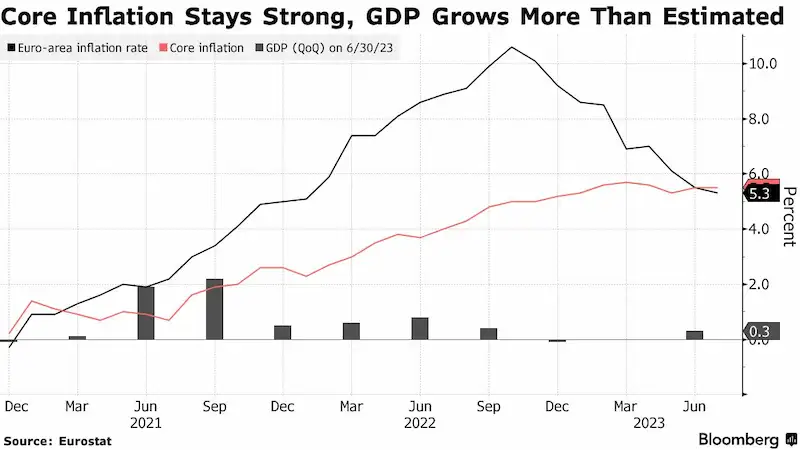


The recent data released by Eurostat indicates that the eurozone economy has returned to growth, raising the possibility of the European Central Bank (ECB) considering another interest rate hike. The second-quarter gross domestic product (GDP) showed a 0.3% increase compared to the previous three months, exceeding economists' expectations of a 0.2% rise.
Meanwhile, consumer prices in the eurozone rose by 5.3% in July, meeting expectations. However, the closely monitored underlying inflation measure, which excludes volatile costs such as food and energy, slightly exceeded estimates at 5.5%, surpassing the headline gauge for the first time since 2021. These inflationary pressures suggest that the ECB might need to take further action.
The positive GDP growth is partially attributed to a strong performance from Ireland, which expanded by 3.3% in the second quarter. However, concerns remain regarding the overall economic outlook in the region. The ECB has already raised rates for a ninth time since July 2022, but they recently warned about the looming risks and a possible "hard-ish landing." Confidence indicators are signaling weakness, and analysts, including Gilles Moec from AXA, have expressed concerns about the future of the eurozone.
Furthermore, the manufacturing downturn that started a year ago is now impacting the service sector as well. With the summer tourism season winding down, there are concerns about a further slowdown in services. Companies' demand for loans is plummeting, and housing and business investment are also showing signs of weakness. Even Germany, the largest economy in Europe, has been struggling, with output stagnating in the second quarter after barely emerging from a recession earlier this year.
Leading companies in the region, like Bayer AG, BASF SE, Lanxess AG, and Hamburger Hafen, have issued warnings about the deteriorating outlook, adding to the concerns. As the deposit rate reaches 3.75%, it is likely that the ECB has reached the end of its rate increases. ECB President Christine Lagarde has emphasized the need for caution in the face of uncertainty, suggesting that a pause or one final rate hike might be the options for the next policy decision in September.
The upcoming ECB meeting is expected to be a close call, with various economic data reports due in the meantime. Italy recently reported a decline in GDP in the second quarter, reflecting weakened domestic demand. However, France and Spain reported positive growth. A more detailed breakdown of the data will be provided by Eurostat on September 7. The economic situation in the eurozone remains uncertain, and further developments will play a crucial role in determining the ECB's future policy decisions.