


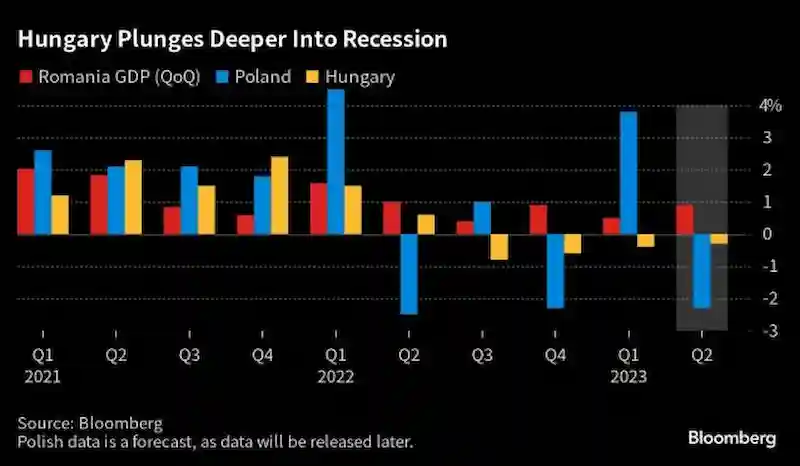


Hungary's economy unexpectedly contracted for the fourth consecutive quarter, plunging deeper into recession and facing the longest period of economic contraction in over 28 years. The country's GDP shrank by 0.3% from April to June, defying expectations of a 0.2% growth predicted by analysts. Additionally, Hungary's economy contracted by 2.4% compared to the same period last year, marking the most significant decline since records began in 1995.
The dismal economic performance can be attributed to several factors, including the ongoing conflict in Ukraine, which continues to undermine economic growth across Eastern Europe. Russia's invasion has led to skyrocketing inflation in the region, prompting central banks to raise interest rates to combat rising prices. As a result, businesses and consumers are cutting back on spending, further stifling economic expansion in countries from the Baltic to the Black Sea.
The impact of inflation and the tightening of monetary policies should have started to ease by the end of last quarter, according to experts. However, weak demand in the euro area is also hampering the region's exports, exacerbating the economic downturn. Although some improvement is expected as inflation begins to subside and central banks normalize monetary policy, economists anticipate that any recovery in domestic demand will be slow and gradual, not gaining significant momentum until the end of the year.
The economic challenges extend beyond Hungary. Poland, the largest economy in the region, contracted by 3.7% in the second quarter, driven by high inflation rates. The cost-of-living crisis in Poland has become a major point of contention in the upcoming elections, with the ruling Law & Justice party leading in opinion polls but unlikely to secure a majority.
Similarly, the Czech Republic experienced minimal growth of just 0.1% from the previous quarter, despite a decrease in inflation in June. Romania fared slightly better, with a quarterly growth of 0.9%, although annual growth was lower than expected due to a decline in industrial production and services.
Overall, Eastern European economies are facing significant challenges due to inflation, tightening monetary policies, and weak demand in the euro area. While some gradual improvement is anticipated in the coming months, a robust recovery is not expected until the end of the year.