


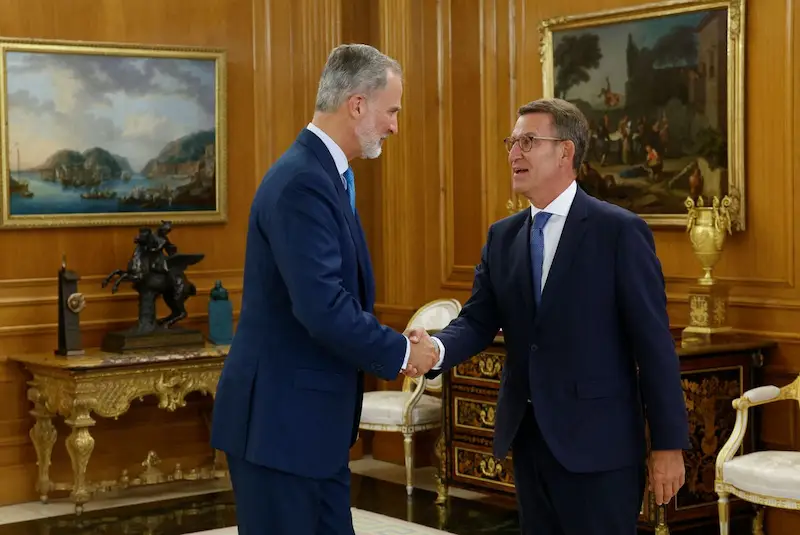


Spain's King Felipe VI has invited opposition leader Alberto Nunez Feijoo to try and form a government in an effort to break the ongoing political deadlock. Feijoo's People's Party holds the largest number of seats in the Spanish Parliament, with 137, but falls short of the 176 needed for a majority. By gaining support from lawmakers in three other groups, Feijoo could potentially reach 172 seats. However, the invitation from the king places him in a challenging position, as neither Feijoo nor acting Prime Minister Pedro Sanchez, the two main candidates, are guaranteed to be able to form a government, risking an extended stalemate.
Since ascending to the throne nine years ago, King Felipe has faced a turbulent political landscape in Spain. The country's traditional two-party system has crumbled, with the emergence of new parties on both the left and right. Felipe has witnessed the first successful no-confidence vote and the only coalition government since Spain's return to democracy in the 1970s. Additionally, he experienced a major constitutional crisis when the Catalan government attempted to declare independence in 2017.
Late on Tuesday, the Royal House stated that no evidence emerged during the king's discussions with political leaders of the existence of a majority, prompting Felipe to adhere to the tradition of inviting the candidate with the most votes to attempt to become the premier. The timing of the investiture vote will be determined by the speaker after consultation with Feijoo.
Following his meeting with the king, Feijoo expressed his acceptance of the invitation and his intention to engage in discussions with other parliamentary groups to secure the necessary four additional seats. However, this task proves challenging as all other parties strongly oppose aligning with the People's Party's main ally, a far-right group. Consequently, it may take months before a government can be formed or new elections are called.
Feijoo requires an absolute majority or a simple majority in a second vote to secure the position, leaving a chance for Sanchez, whose Socialists hold 121 seats and garner support from Sumar, a left-wing coalition partner with 31 seats, as well as approximately 19 lawmakers from other parties. Nevertheless, this would still leave them short of a majority in the 350-seat chamber.
Sanchez recently achieved a significant victory by securing the appointment of a Socialist speaker with the support of a Catalan separatist group. However, these same separatists are now demanding a sweeping amnesty for hundreds of activists facing legal action for their involvement in the failed 2017 declaration of independence, including Carles Puigdemont, the former regional president.
Esteban Gonzalez Pons, a top official of the People's Party, announced that the party will seek the support of various groups, including Puigdemont's separatists, to increase the chances of Feijoo's election.
The election of the speaker also highlights the fragility of the right-wing bloc, as the People's Party and nationalist group Vox had initially indicated that they would vote together as part of a broader alliance. However, when it came time to vote for the speaker, Vox chose to support its own candidate.
In 2016, former caretaker Prime Minister Mariano Rajoy rejected an invitation from the king to seek investiture due to insufficient support in parliament, opting for the possibility of a second election. He retained the position when the rival Socialists abstained. In 2018, Rajoy was ousted from office through a successful no-confidence vote led by Sanchez.