


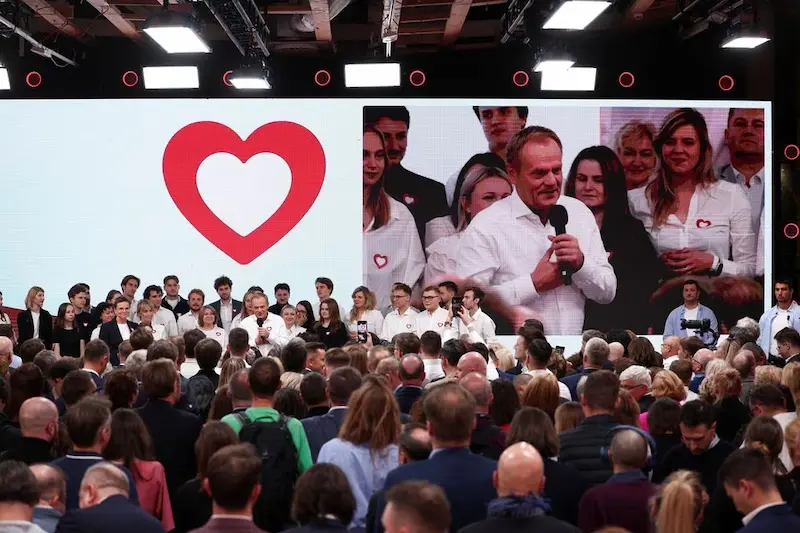


In a major political shift in Poland, the ruling Law and Justice (PiS) party is on track to lose its parliamentary majority, according to official partial results and exit polls. This election is being seen as one of the most pivotal in decades, and the liberal, pro-EU opposition parties look poised to form the next government. Since coming into power in 2015, the PiS party has clashed repeatedly with the European Union over issues like the rule of law, media freedom, migration, and LGBT rights. The opposition parties, led by former European Council President Donald Tusk's liberal grouping Civic Coalition (KO), have promised to repair ties with Brussels and reverse the democratic reforms they believe have eroded Poland's democracy.
According to a late exit poll by Ipsos, the PiS party is projected to receive 36.1% of the vote, which would translate into 196 seats in the 460-seat lower house of parliament. On the other hand, the opposition parties, with the KO leading the way, are expected to win a combined 249 seats, with the KO projected to receive 31.0% of the ballots cast. The official results, with 90% of voting districts counted, show the PiS party with 36.4%, the KO with 29.7%, and its ally, the center-right Third Way, with 14.5%. It is worth noting that conservative rural areas and smaller towns tend to report their results faster, whereas larger cities, where liberal parties have a stronger presence, take longer.
If the opposition secures victory in this election, which analysts consider to be the most significant for Europe in years, it has the potential to redefine Poland's relationship with the European Union. Financial markets in Poland reacted positively to the prospect of a government led by Donald Tusk, with the blue-chip WIG 20 share index surging by 6.2% and the zloty currency gaining 1.3% in value. Analysts believe that the removal of the nationalists from power will help to mend Poland's strained relations with the EU, fostering economic growth and attracting capital inflows.
Donald Tusk has expressed his intention to unlock approximately 110 billion euros of EU funds earmarked for Poland but suspended due to concerns over the country's adherence to the rule of law. Meanwhile, President Andrzej Duda, an ally of the PiS party, has acknowledged that the winning party should get the first opportunity to form a government. While waiting for the full election results, Duda has called for patience, emphasizing the stability of democracy in Poland.
However, with the far-right Confederation party underperforming with only 6.8% of the vote, PiS will face challenges in forging a new government. Third Way leader Szymon Holownia stated that coalition talks among the opposition parties will commence this week, with Donald Tusk being a natural candidate for the position of Prime Minister.
The leader of the Polish Peasants' Party (PSL), a part of the Third Way alliance, ruled out the possibility of joining a PiS-led coalition, stating that the voters who supported them wanted change and the removal of the PiS party from power.
Notably, the Organization for Security and Cooperation in Europe (OSCE), a rights watchdog, has raised concerns about the fairness of Poland's election. The OSCE's Parliamentary Assembly head, Pia Kauma, stated that the ruling party had an unfair advantage through its influence over state resources and public media.
This election has seen a high turnout, with 74% of eligible voters casting their ballots, the highest since the fall of communism in 1989. This underscores the crucial nature of this election for Poland. In a contentious campaign, the PiS party focused on framing the election as a choice between uncontrolled illegal migration under foreign-influenced leaders and a government that would protect Poland's borders and traditions. However, the party faced criticism for democratic backsliding and undermining women's rights with the enforcement of a near-total abortion ban in 2021. Additional accusations were made against PiS for using positions in state-controlled firms as rewards for supporters.
As the election results unfold, many hope for a government that will prioritize the rights and safety of women and address nepotism in state institutions. Regardless, this election marks an important turning point in Polish politics and could have significant implications for the country's future relationship with the European Union.