


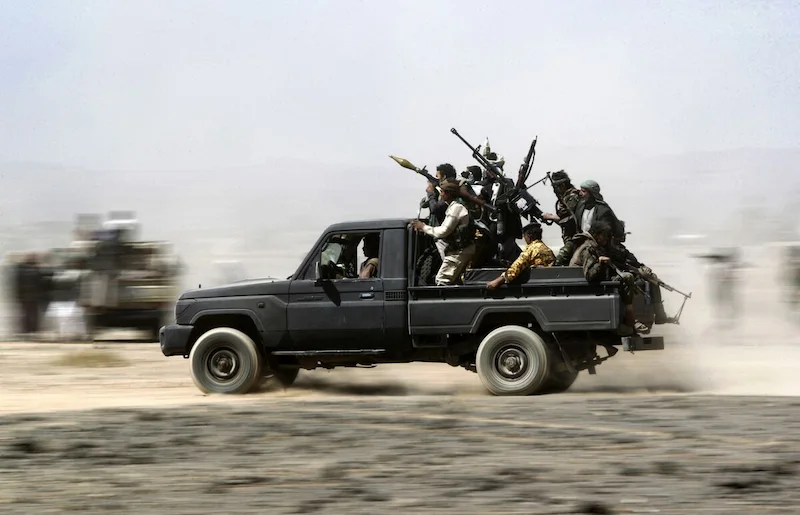


Saudi Arabia's military has been placed on high alert after engaging in deadly clashes with Yemen's Iran-backed Houthi rebels. In addition to the clashes, the rebels attempted to fire a missile towards Israel, prompting heightened tensions in the region. Sources reveal that four Saudi soldiers lost their lives during the fighting in Jazan Province, which lies on the border between Saudi Arabia and Yemen.
This incident marks the first known casualties suffered by Saudi forces since a tentative truce was established with the Houthi rebels in April last year. Efforts had been underway to negotiate an end to the conflict, which has been ongoing since 2015. However, the recent escalation has disrupted the progress made, with tensions mounting in the aftermath of the Israeli-Hamas conflict, which has garnered significant attention across the Middle East.
Of note, Iran has issued warnings that new fronts will emerge against the United States if it continues to support Israel. Saudi Arabia has been highly critical of Israeli airstrikes on Gaza, calling for an immediate ceasefire. The recent clashes on the Yemen-Saudi border followed the Houthi rebels' launch of multiple cruise missiles and drones towards Israel on October 19. According to reports, US and Saudi Arabian air defenses intercepted these missiles, with one falling within Saudi territory.
As a result of these developments, Saudi Arabia has activated protocols associated with a heightened state of readiness across all branches of its military. The country's Defense Minister, Khalid Bin Salman, is currently in Washington to meet with senior officials of the Biden administration. The discussions are expected to address the fallout from the Israel-Hamas conflict as well as the situation in Yemen.
It is worth mentioning that the Houthi rebels have expressed their support for Hamas, a group designated as a terrorist organization by the US and the European Union. On October 11, the Houthi leader, Abdel-Malek Al-Houthi, condemned countries like Saudi Arabia for attempting to normalize relations with Israel and threatened to retaliate against the US using "all available military options."
In another development, Israel's main airline, El Al, has adjusted its flight paths over the Arabian Peninsula as a precautionary security measure. Flights from Tel Aviv to destinations such as Bangkok and Mumbai have been detoured southwards, avoiding the bulk of Saudi Arabian airspace. This move has been made without any specific threats being reported, and El Al is still permitted to fly through Saudi airspace.
Furthermore, there have been reports that Oman, located at the tip of the Arabian Peninsula near Yemen, has closed its airspace to Israeli flights. The closure has disrupted flight routes and added additional travel time for Israeli carriers. Oman had only recently opened its airspace to Israeli airlines in the past year and a half, although it does not officially recognize Israel.
As tensions continue to rise in the region, the situation remains fluid, and further developments may be anticipated.