


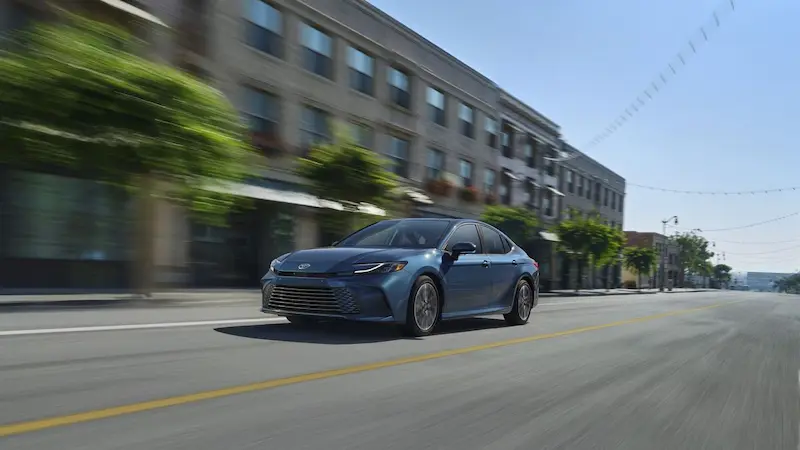


Toyota's Camry has been the best-selling passenger car in the US for an astonishing 22 consecutive years. That's a remarkable feat, and it highlights the enduring popularity of this sedan. However, Toyota is set to make a significant change to the next generation of the Camry, one that could have a profound impact on the industry. They are introducing a hybrid powertrain option across the entire Camry lineup, making it the sole choice for potential buyers. While this may not be the fully electric future that environmentalists have been advocating for, it does represent a bold move towards a more sustainable automotive landscape.
While electric vehicles (EVs) are gaining traction worldwide, automakers like Volkswagen, General Motors, and Ford are still grappling with the challenge of widespread EV adoption. Building electric vehicles alone is not enough to guarantee success, and Toyota, as the world's top-volume automaker, understands this. They recognize that many consumers are not quite ready to embrace fully electric vehicles as their next purchase. Even Tesla, the leader in the US EV market, is experiencing slower growth and is moving into what their head of investor relations describes as an "intermediate low-growth period." This indicates that the transition to EVs is not as straightforward as originally anticipated.
Toyota's decision to focus on hybrids may not excite environmentalists or thrill car enthusiasts, as hybrids are often associated with utilitarian vehicles rather than performance-driven machines. However, Toyota's track record speaks for itself. They have consistently prioritized quality, durability, and reliability over flashier attributes like styling and horsepower. This approach has paid off handsomely, leading to their dominance in sales charts.
While Toyota acknowledges the need to accelerate their EV efforts, they still firmly believe that gas-electric hybrids contribute significantly to reducing emissions. Toyota's cumulative sales of over 23 million electrified vehicles, primarily hybrids, have effectively reduced CO2 emissions by a staggering 176 million tons. For them, the enemy is carbon, and hybrids have proven to be an effective weapon in the battle against climate change.
There is a growing sentiment that the narrative around carbon neutrality and EVs needs to evolve. Toyota's chief scientist, Gill Pratt, believes that simplistic answers are no longer sufficient and that a wider aperture is required to solve the problem on a grander scale. He highlights the challenges with affordability as a significant hurdle for EV sales growth. This perspective suggests that time is on Toyota's side as they pursue pragmatic solutions that can make a substantial impact in reducing carbon emissions.
While the push for electrification continues, concerns have been raised about the selling practices in the automotive finance industry. Brokers have been accused of selling car loans to customers who are unable to repay them, echoing the practices that led to the 2008 global financial crisis. This revelation serves as a reminder that the automotive industry must prioritize responsible lending practices to avoid potential future crises.
In the midst of this evolving landscape, Renault, a long-time partner of Nissan, plans to sell a 28% stake in the latter as part of their ambitious electric vehicle development plan. Renault aims to raise funds for their EV business, Ampere, through an initial public offering. This move signals Renault's commitment to the electric vehicle market and their determination to remain at the forefront of this technological shift.
Toyota's decision to make the Camry purely hybrid is a bold move that highlights the company's focus on sustainability and reducing carbon emissions. While the world eagerly anticipates a future dominated by fully electric vehicles, Toyota's emphasis on hybrids acknowledges the reality that many consumers are not ready to make that leap just yet. By offering a hybrid option across their entire Camry lineup, Toyota is providing consumers with a compelling alternative that combines fuel efficiency, reduced emissions, and the reliability for which they are renowned.