


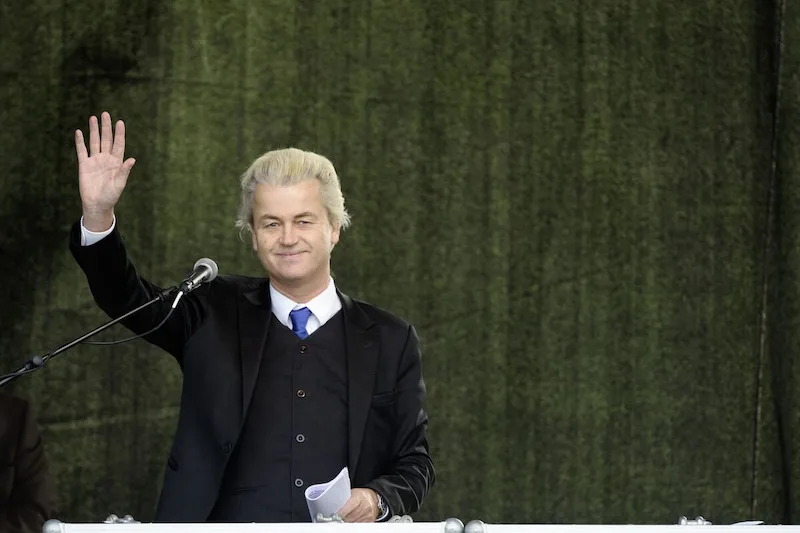


Geert Wilders, a far-right lawmaker in the Netherlands, appears to be on track to lead the largest bloc in the country's parliament, according to an exit poll from public broadcaster NOS. His Freedom Party is projected to win 35 seats, falling short of the 76 seats required for a majority. As a result, Wilders may face challenges in forming a coalition government, as some rival parties have already ruled out working with him due to his anti-Islamic views.
Wilders, known for his controversial statements and living under police protection for decades, celebrated the exit poll results alongside his team. His party's late surge in the campaign was fueled partially by the vacuum left by outgoing Prime Minister Mark Rutte's departure from politics after a 13-year tenure. Additionally, the refusal of Rutte's successor, Dilan Yesilgoz-Zegerius, to categorically reject the possibility of working with Wilders also contributed to his momentum. The issue of anti-migration, a long-standing focus for Wilders, was a prominent theme during the election campaign.
The Left alliance led by Frans Timmermans is projected to secure second place with 26 seats, while Yesilgoz-Zegerius's VVD is expected to claim 23 seats. A new party formed by lawmaker Pieter Omtzigt is projected to receive 20 seats, according to the exit poll conducted at 9 p.m. local time.
If Wilders plays a significant role in the next government, it would introduce a euroskeptic perspective into one of the European Union's stalwart members. Wilders has advocated for the Netherlands to withdraw from its international climate commitments and has proposed a binding referendum on leaving the EU, which he refers to as "Nexit."
Despite being a long-time parliamentarian, Wilders has only participated in government once, between 2010 and 2012, when he provided support to Rutte's minority coalition from outside the government. However, after Wilders made derogatory remarks about people of Moroccan descent and faced legal consequences, Rutte ruled out any future collaboration with him.
It is possible that the outgoing caretaker government led by Rutte may continue to preside for some time, particularly if Wilders' strong showing complicates the coalition-building process. Although Yesilgoz-Zegerius hinted at the possibility of forming a coalition with Wilders prior to the election, she made it clear that she would not serve under him as prime minister. In the previous election, it took nine months and four parties to negotiate a majority government.