


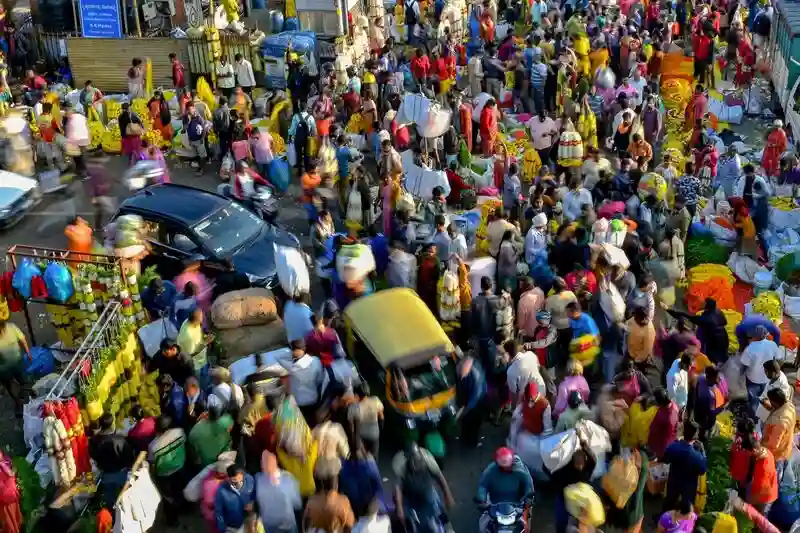


India has surpassed China to become the world's most populous country, according to new data released by the United Nations. The latest mid-2023 estimates from the UN's World Population dashboard show that India's population has risen to 1.4286 billion, while China's stands at 1.4257 billion (excluding Hong Kong, Macau, and Taiwan).
India's growing population is set to add pressure on the government to create employment opportunities for the millions of young people entering the workforce. With half of the country's population under the age of 30, India is predicted to become the world's fastest-growing major economy in the coming years.
India now accounts for almost a fifth of the world's population, surpassing the populations of Europe, Africa, and the Americas individually. While China currently shares this distinction, India's population is expected to continue growing, reaching 1.668 billion by 2050, while China's population is projected to decline to around 1.317 billion.
According to Andrea Wojnar, the Representative of the United Nations Population Fund in India and Country Director Bhutan on State of the World Population Report, "India's story is a powerful one. It is a story of progress in education, public health and sanitation, economic development as well as technological advancements."
India's population growth has been driven by the arrival of approximately 23 million babies in 2022. Meanwhile, China's population shrunk for the first time in six decades, with only 9.56 million newborns last year.
Chinese Foreign Ministry spokesman Wang Wenbin has emphasized that population dividends are not solely determined by quantity, but also by quality. He stated that China's population, which currently stands at over 1.4 billion, still possesses a talent dividend and strong development potential.
The global population is growing at its slowest rate since 1950, and the UN predicts that it could reach 8.5 billion in 2030, rising to 9.7 billion in 2050 before peaking at around 10.4 billion in the 2080s. More than half of the projected increase in the global population between 2022 and 2050 is expected to take place in eight countries: the Congo, Egypt, Ethiopia, India, Nigeria, Pakistan, the Philippines, and Tanzania.