


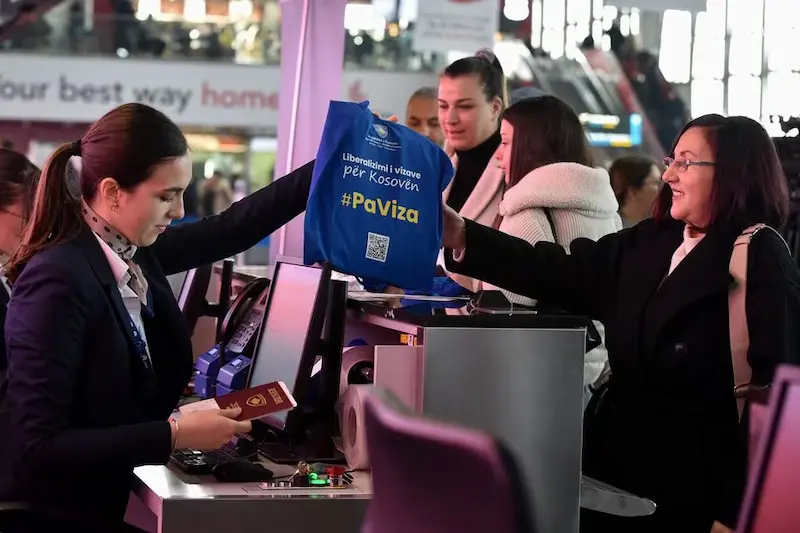


In a moment of celebration and long-awaited freedom, hundreds of Kosovars rushed to Pristina airport on Monday to embark on their journeys to EU countries. The occasion marked the lifting of visa requirements for Kosovo citizens, finally granting them the same privileges as their counterparts in the Western Balkans. The Schengen area, with its policy of open borders, allows over 400 million people to travel freely between member countries without undergoing border checks. Kosovars, previously the sole citizens in the region requiring visas, now find themselves unburdened by travel restrictions.
Among the exuberant travelers at Pristina airport was Habib Spahiu, who joyfully expressed, "I do feel as free as a bird now that I can travel all over (Europe)." Accompanied by his son, Spahiu was part of a lucky group of 50 individuals who won a state lottery organized by the government to commemorate the visa-free process. The excitement engulfing the airport was matched by the presence of Prime Minister Albin Kurti, who personally greeted the travelers and shared their joy.
The journey towards visa-free travel for Kosovo has been a long and arduous one. Despite declaring independence from Serbia in 2008, Kosovo has faced ongoing obstacles in its quest for international recognition. While over 110 countries recognize Kosovo's statehood, it remains excluded from becoming a member state of the United Nations due to objections from Serbia, Russia, and China. This exclusion also extended to visa-waiver programs, limiting the mobility of Kosovo citizens and dampening their prospects for economic opportunities.
However, after years of tough requirements and domestic disputes, the European Union finally announced in 2018 that all necessary conditions for visa-free travel had been met. Yet, the decision faced further delays due to concerns from France and the Netherlands regarding the potential for an increase in migration. Nonetheless, Kosovo's persistence prevailed, and as the day arrived, the exhilaration among its citizens became palpable.
Kosovo, being one of the poorest countries in Europe, sees the visa waiver as more than just a travel privilege. For many Kosovars, it represents an opportunity to seek employment abroad and improve their economic circumstances. "I am going to Germany for a few days, just to explore job possibilities, and I will return to apply for a working visa," shared a construction worker at the airport who preferred to remain anonymous. The job market in Kosovo has long struggled to meet the demands of its population, and the visa-free access to EU countries opens doors to new prospects for better livelihoods.
While celebrating this newfound freedom, the government has urged its citizens not to misuse the Schengen rules. According to the regulations, individuals are allowed to stay as tourists for up to 90 days within a 180-day period but are not permitted to work during this time. The government emphasizes the importance of adhering to these guidelines, avoiding any potential misunderstandings or conflicts that could jeopardize the visa-free privilege.
As Kosovars embark on their journeys to various EU destinations, an air of hope and possibility fills the Pristina airport. With visa-free travel becoming a reality, the citizens of Kosovo are now able to explore Europe with newfound liberty and embrace the opportunities that lie ahead.