


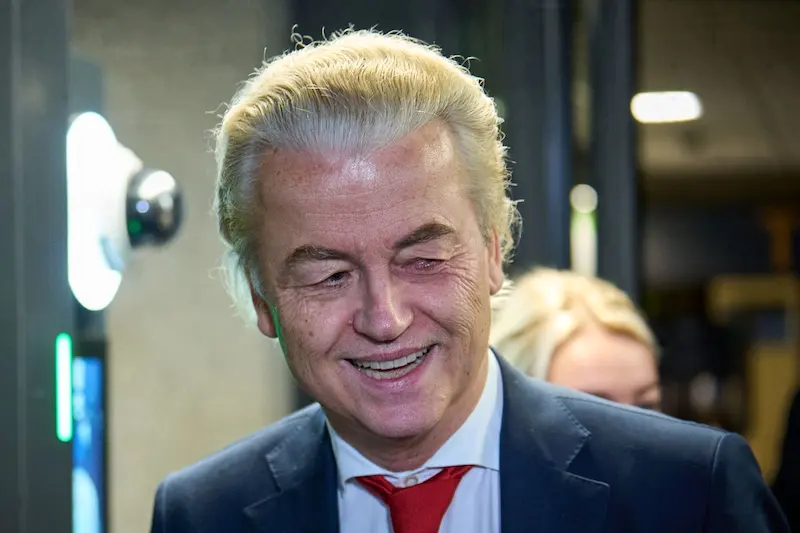


The political landscape in the Netherlands seems to be heading towards a possible snap election as Geert Wilders, the leader of the far-right Freedom Party, faces challenges in his efforts to form a government and become the country's prime minister. Late on Tuesday, one of the most likely coalition partners ruled out joining Wilders' cabinet, creating another snag in his path to power. Although there are still potential pathways to break the impasse, some political parties, including those involved in coalition talks, are already preparing for the possibility of new elections later this year.
Despite the obstacles, Wilders remains in a position of strength, as recent polls indicate that support for his party has increased since the November election when he secured a quarter of the votes. The Netherlands has been no stranger to lengthy post-election negotiations in the past. The last time it took parties nine months to form a government, although that situation did not involve the controversial figure of Wilders and his history of making extreme statements about minorities, which has alienated potential coalition partners.
Following the election, Wilders attempted to rebrand himself as "Geert Milders," signaling a willingness to compromise. This softer stance initially allowed coalition talks to proceed constructively. However, the leader of the center-right New Social Contract party, Pieter Omtzigt, recently declared that his party would not take seats in Wilders' cabinet. Omtzigt did leave open the possibility of supporting a minority government led by Wilders through ad-hoc external votes. While such a backtrack is not unprecedented, it has increased the likelihood of a snap election this year.
Stefan Couperus, an associate professor of political science at Groningen University, states that the recent developments make the chances of a new election stronger. Nevertheless, he expects the ongoing talks to continue for the time being, even though their progress may be hindered. Wilders expressed disappointment with Omtzigt's decision, stating that he didn't understand why he gave up while negotiations were ongoing.
Wilders' Freedom Party surprised many by winning 37 seats in the November election, more than any pre-election polls had predicted. Omtzigt, initially considered a front-runner for prime minister, lost ground due to public hesitation regarding whether he wanted the top job. Wilders, in order to achieve a majority of 76 seats in parliament, must form alliances with other parties, such as the People's Party for Freedom and Democracy, led by outgoing Prime Minister Mark Rutte, Omtzigt's New Social Contract, and the Farmer-Citizen Movement.
In a potential scenario where Wilders fails to form a coalition, Frans Timmermans, the leader of the Left alliance, technically has the opportunity to try to establish a government. However, Couperus deems Timmermans' chances of success unrealistic, given the overwhelming support for right-wing parties in the last election.
Wilders expressed his hope that Omtzigt would not engage with Timmermans, emphasizing that the voters desire a right-wing cabinet. The situation remains uncertain, but one thing is clear: the Netherlands is facing a period of political turmoil, with the potential for a snap election on the horizon.