


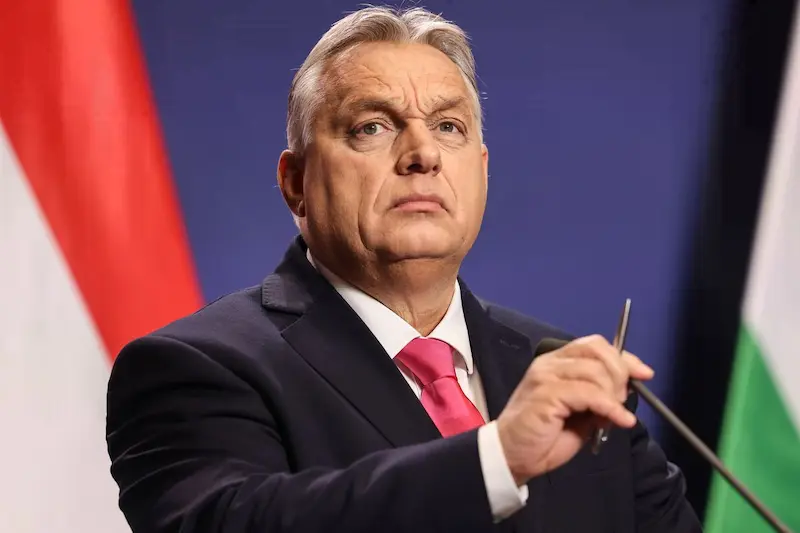


Hungarian Prime Minister Viktor Orban is facing a significant political crisis following the shocking resignation of the country's head of state, President Katalin Novak. The resignation came as a result of a controversy surrounding a pardon granted by Novak in a child sex-abuse case, which could potentially impact the ruling party's upcoming campaign in local and European Parliament elections in June. In addition to Novak, Judit Varga, who was set to lead the European campaign for Orban's Fidesz party and who had approved the pardon as Justice Minister, has also stepped down.
Orban's attempt to move forward in light of these events has encountered obstacles. In a recent interview on the Partizan Youtube channel, Peter Magyar, a former state company executive and the ex-husband of Judit Varga, claimed that the two prominent female leaders were sacrificed in order to salvage the popularity of the ruling party. Magyar also accused the Orban government of engaging in intimidation tactics and corruption. These criticisms from an individual close to Orban's inner circle suggest that there may be infighting within the elite ranks of power, which could create uncertainty within the halls of government.
Despite these allegations and resignations, there is speculation that Orban may emerge relatively unscathed if the public believes he acted swiftly to contain the fallout. Orban's Fidesz party continues to be highly popular in Hungary, and the prime minister maintains a firm grip on power. However, this scandal could potentially impact the ruling party's performance in the upcoming elections, particularly as Orban seeks to solidify control over the remaining strongholds of the opposition and position himself as a leader of the far-right movement in Europe.
Orban, who leads an all-male cabinet, has remained silent since the resignations. Prior to these events, he attempted to limit the damage by proposing a constitutional amendment that would prevent the president from pardoning crimes against children. It is expected that Orban will address the situation and present his political outlook at his annual state-of-the-nation speech on Saturday. He may also take the opportunity to nominate a successor to President Novak. Given that Orban's party holds a significant majority in parliament, it is likely that the nomination and any associated legislation will pass with ease.
This scandal comes at a delicate time for Orban, as his relationships with Hungary's European Union and NATO partners have been strained due to his close ties with Russia and China, as well as his attempts to undermine support for Ukraine. Earlier this month, Orban had to backtrack on his opposition to an EU aid package for Ukraine and may now facilitate parliament's approval of Sweden's NATO membership, which Hungary had been delaying for over a year and a half.
The coming weeks will be crucial for Orban as he works to resolve the political crisis and regain control over the narrative. The upcoming elections will test the resilience of his party's support and determine the long-term effects of this scandal on Orban's leadership and Hungary's political landscape.