


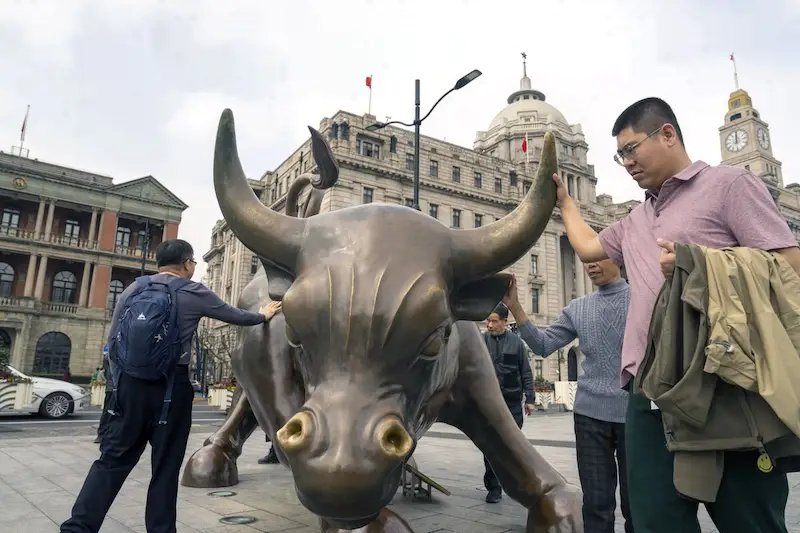


Amidst China's ongoing stock market tumult, regulators have imposed new restrictions on major institutional investors to manage the crisis effectively. These investors are now prohibited from taking net sell positions during the first and last 30 minutes of trading, allowing the government-backed "national team" to exert more influence on share movements. This move comes as Chinese equities have shed over $6 trillion since their 2021 peak, highlighting the challenges President Xi Jinping faces in steering the country towards a new growth model.
The recent clampdown on quantitative trading signals a targeted approach by newly appointed regulatory head Wu Qing to address vulnerabilities in the financial system that could pose systemic risks. Drawing parallels to the 2007 US market crash preceding the sub-prime mortgage crisis, the concerns raised by the Man Group's Ziang Fang underscore the potential gravity of China's current situation. In fact, it is believed that these funds played a significant role in the historic crash of China's small-cap stocks earlier this month.
For President Xi, navigating these hazards is imperative for the successful implementation of China's economic transformation. While the current interventions have temporarily halted the market selloff, sustaining artificially buoyant markets may mask the underlying challenges faced by many. With reports indicating a decline in salaries for nearly a third of office workers and an uptick in economic-related protests, it is evident that China's middle class is apprehensive about their future prospects.
Beyond the immediate market dynamics, China's regulatory actions could have broader implications. By sidelining major asset managers and distorting prices to prop up markets, there is a risk of undermining the country's efforts to create efficient markets integrated with the global financial system. As policymakers strive to strike a balance between stabilizing the market and fostering sustainable growth, the challenges ahead remain daunting.
In the global arena, geopolitical tensions are also escalating, with Israel contemplating a plan to relocate Palestinian civilians ahead of a potential assault on Gaza, and Ukraine inching closer to securing a crucial disbursement from the International Monetary Fund. Meanwhile, in the US, immigration rules are under scrutiny as the Biden administration explores executive action amid congressional gridlock.
As China grapples with its market woes and global dynamics continue to evolve, President Xi Jinping faces a complex landscape where economic stability, social discontent, and geopolitical pressures converge. The path forward for China's economic reform agenda remains fraught with challenges, underscoring the delicate balancing act required to navigate the country's transition towards a sustainable growth model.