


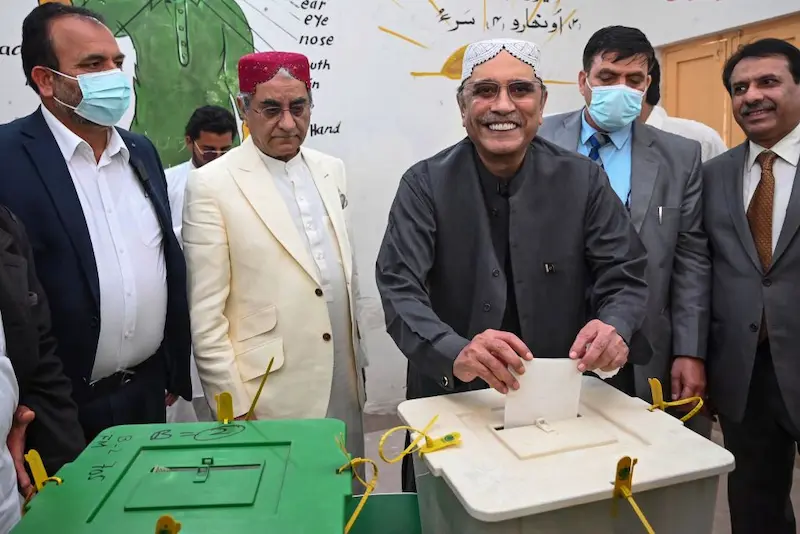


In a strategic political move, Asif Ali Zardari secures a second term as President of Pakistan, supported by Prime Minister Shehbaz Sharif's allies. During the voting process, Zardari garnered 411 votes, decisively defeating the candidate put forward by incarcerated former leader Imran Khan, who received a mere 181 votes. This election outcome marks the continuation of a long-standing political alliance between Zardari and Sharif and highlights their influence within the Pakistani political landscape.
The presidency in Pakistan is largely ceremonial, but Zardari, a seasoned politician, has demonstrated his ability to wield significant power behind the scenes. Having already stripped the position of most formal powers during his previous presidential term in 2009, Zardari's return to the role signifies a potential continuation of his influential role in shaping political decisions and alliances in the country.
Zardari's Pakistan Peoples Party (PPP), the third-largest group in the National Assembly, entered into an agreement to support Sharif as Prime Minister after the February elections. However, the PPP opted not to join Sharif's cabinet, raising concerns about potential instability in the new government. This political configuration could potentially lead to a scenario where Sharif's government is reliant on support from the PPP, impacting key policy decisions and reforms.
Analysts believe that Zardari's re-election as President solidifies his position within the power structure of Pakistan, with Sharif's government potentially being beholden to the PPP's interests. This dynamic could complicate Sharif's plans to secure significant loans from the International Monetary Fund and implement the necessary reforms to stabilize the country's economy. The PPP's resistance to certain IMF reform measures, such as the privatization of state-run enterprises, may further complicate the situation.
As Zardari embarks on his second term as President, his focus remains on collaborating with Prime Minister Sharif to address the economic challenges facing Pakistan. Zardari's reputation as a skilled political operator, honed through years of navigating Pakistan's complex political landscape, positions him as a key player in shaping the country's future direction. Time will tell how this renewed alliance between Zardari and Sharif unfolds and impacts Pakistan's political and economic landscape in the months to come.