


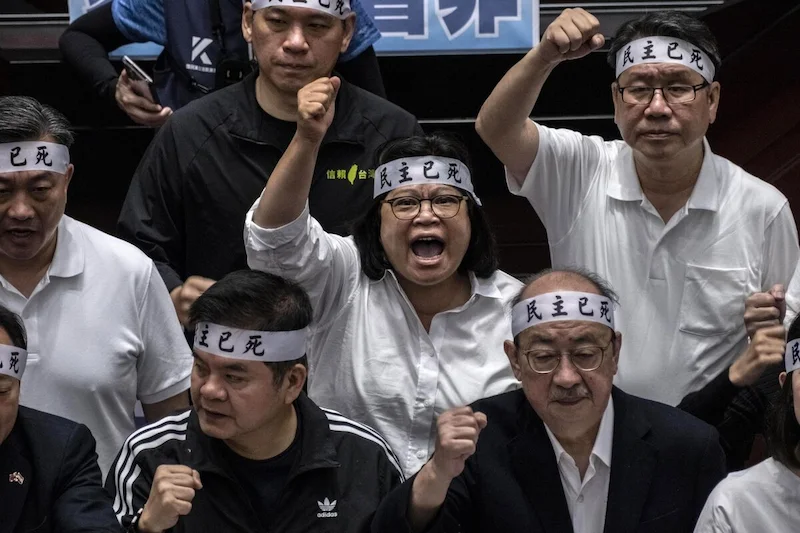


Supporters of Taiwan’s newly-elected President, Lai Ching-te, are rallying against efforts by the China-leaning opposition to limit the president's authority. Lawmakers from the Kuomintang have initiated the final steps towards passing a law that would require President Lai to address them annually, respond to inquiries separately, and provide various documents upon request. Additionally, officials could face imprisonment if found lying to the legislature, potentially tying up the president's administration in legal proceedings.
The proposed legislation, which could be approved in the imminent days, poses a challenge to President Lai's governance, especially in the technology hub amidst escalating US-China tensions. The ruling Democratic Progressive Party has criticized the rushed process, citing inadequate consultations, while the KMT asserts that the proper procedures have been followed.
Wen-ti Sung, a nonresident fellow with Atlantic Council’s Global China Hub in Taipei, expressed concerns that the opposition's rushed advancement of the bill without public or parliamentary input aims to weaken the government's efficacy. Last week, legislative scuffles led to minor injuries, highlighting the contentious nature of the bill.
In response, DPP lawmakers attempted to stall the bill's progression, leading to colorful scenes in the typically solemn legislature with both parties waving posters. Outside, hundreds of Lai supporters assembled to demand further discussions on the KMT's proposed legislation, advocating for democratic processes.
Preparations for larger protests seem underway, with activists setting up tents, medical facilities, and donation stations. Some compare the current situation to the 2014 Sunflower Movement, where protesters halted lawmakers' activities for weeks to oppose increased trade with China.
President Lai's presidency, winning 40% of votes in a three-party race this year, is expected to face challenges amid the KMT's legislative majority. His stance on Taiwan's sovereignty, as highlighted in his inauguration speech calling for talks with China on equal terms, has already drawn criticism from Beijing, which prefers negotiating with the KMT.
As tensions escalate, China has imposed sanctions on US defense contractors for selling arms to Taiwan, with Lai urging China to halt military intimidation and engage in dialogue on issues like tourism. China’s push to influence Taiwan by courting KMT figures adds to the complexity of the cross-strait relationship, posing further challenges for President Lai in the coming years.