


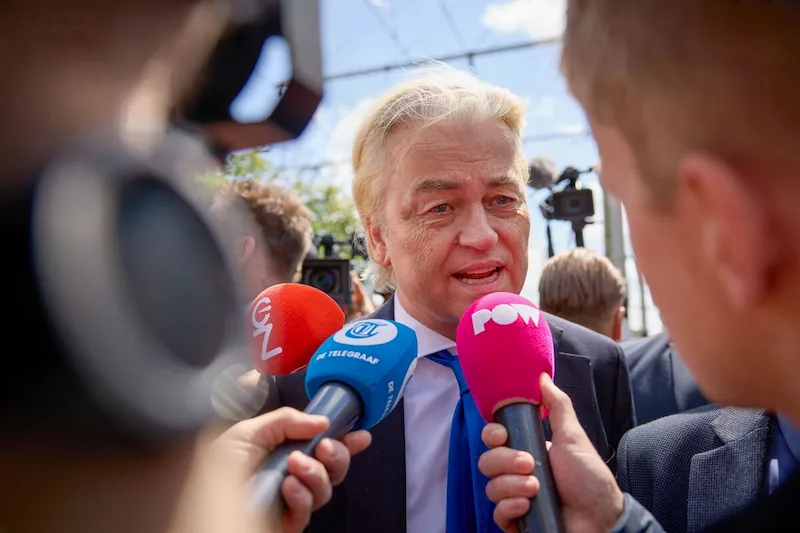


In a surprising twist, a coalition of left-leaning political parties secured the most Dutch seats in recent European Parliament elections, delivering a blow to Geert Wilders and his emerging governing coalition even as his party registered notable gains. Wilders, a prominent figure in conservative populism, found his ambitions partially realized but not to the extent forecasted by pre-election polls.
The Left Alliance, spearheaded by former European Union climate commissioner Frans Timmermans, is poised to capture eight seats, according to exit polls released late Thursday. Timmermans’ coalition includes the Green Left and the Labor parties, both representing significant factions within the EU’s Green Party and Social Democrats, respectively.
Timmermans regarded the victory as demonstrative of a general pro-EU sentiment in the Netherlands. “It is a telling sign that all pro-European parties have performed well in this election,” Timmermans stated. “It shows that a lot of people in the Netherlands support the EU and that a majority of them want a country that contributes to building a stronger Europe.”
This electoral outcome aligns with a recent string of setbacks faced by far-right parties across Europe, decreasing the likelihood of a pronounced rightward shift in the region. It also potentially smooths the path for European Commission President Ursula von der Leyen to secure a second five-year term.
Wilders’ Freedom Party, a key player in the European Identity and Democracy alliance—an alliance inclusive of Marine Le Pen’s National Rally—recorded significant progress, raising its seat count to seven from zero. Despite this, some polls had initially predicted that Wilders would outperform the Left Alliance. Wilders, having led the surprise victory in November’s general election, has been at the forefront of the Dutch coalition negotiations.
Following the election, Wilders declared, “It is a great result. We see in many other countries that parties like mine are either winning or securing top spots. So that is a very positive sign and a clear message to the elites in Brussels that things will change. Nothing will be the same again.”
With the Netherlands initiating the voting process on Thursday, the majority of EU member states are set to cast their ballots on Sunday. The finalized results from the Dutch vote are anticipated for release on Sunday.
Though Wilders recently had to step aside from his prime ministerial ambitions to enable coalition discussions, his Freedom Party, along with the liberal VVD, center-right NSC, and populist Farmer-Citizen Movement, have proposed Dick Schoof, the ex-chief of the Dutch intelligence agency, as their prime ministerial candidate. The newly-formed cabinet, pending formalization by June 26, would see Schoof replace the long-serving premier Mark Rutte.
Modulating his stance in recent months, Wilders has relaxed several of his more controversial anti-Islam policies and has abandoned advocacy for a Nexit referendum, opting instead to promote EU reforms from within. “There is no support, even close to majority, in the Netherlands for Nexit,” Wilders admitted. “We are not advocating for Nexit anymore. We are aiming to change the European Union from within.”
Despite shifting rhetoric, the coalition partners have outlined an agenda to drastically reduce migration and revise environmental regulations. Their government seeks to implement emergency laws to control migrant inflow and will pursue an exemption from the EU’s broader migration policy. Moreover, they intend to curb Dutch financial contributions to the EU by €1.6 billion ($1.7 billion) by 2028.
“If Brussels values democracy, they better listen to us,” Wilders cautioned. “We are coming, and we will change the tune they are singing.”