


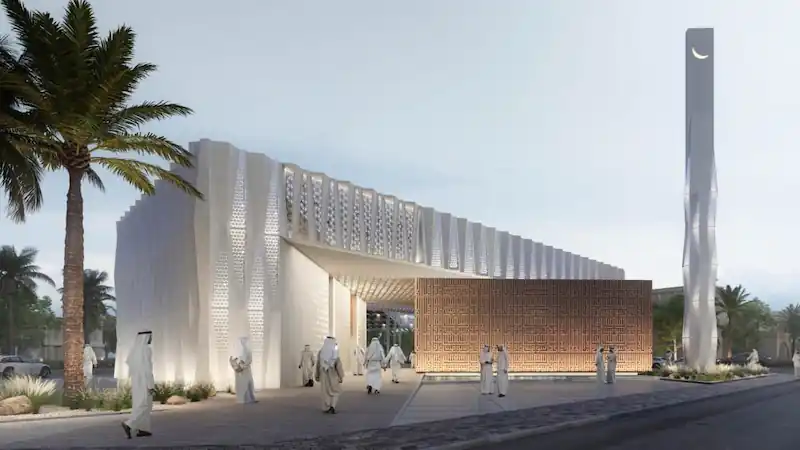


Dubai is set to make history by constructing the world's first 3D-printed mosque. The mosque will be able to accommodate 600 worshippers, spread over an area of 2000 square meters on two floors. The Dubai Government's Islamic Affairs and Charitable Activities Department (IACAD) has stated that the mosque will be made from a concrete mix, with construction scheduled to begin by the end of the year and expected to be completed in the first quarter of 2025.
Ali Mohammad Alhalyan Alsuwaidi, head of engineering at IACAD, has explained that the mosque will be 3D-printed because it is a new and innovative technology that can potentially save time and resources compared to traditional building methods. However, the company responsible for the construction of the mosque has not been named by IACAD.
3D-printing technology for constructing buildings requires large printing machines that are programmed with the design information. They squeeze out the construction material from a nozzle, building up the structure in layers. While the majority of 3D-printed structures are made from concrete, it is also possible to print using other materials, such as clay.
Dubai has set out to become the 3D-printing capital of the world, and in 2018, it launched a "3D Printing Strategy" that aimed for 25% of the emirate's new construction to be 3D-printed by 2030. The city already holds the world record for the largest 3D-printed structure with the Dubai Municipality building, which stands 9.5 meters tall with an area of 640 square meters. Additionally, Dubai is home to the world's first 3D-printed office and a 3D-printed drone research laboratory.
3D-printed buildings are becoming increasingly popular around the world, with examples such as housing for refugees in Jordan, homeless people in Austin, Texas, and even entire neighborhoods like the New Story project in Tabasco, Mexico, which will provide homes for families living in poverty. Theo Salet, the dean of the Department of the Built Environment at Eindhoven University of Technology in the Netherlands, advocates for modernizing the construction industry through technology such as 3D-printing. He believes that digital design and construction will save time, reduce costs, solve the problem of a lack of construction workers and allow us to rethink our designs in terms of sustainability.
While the construction of the proposed mosque is a ground-breaking project, Salet anticipates that it will face challenges. He believes that realizing a large and eye-catching project like this is quite a task, of a scale yet unknown. He added that a project of this scale and ambition is, in his opinion, a project to learn from, and mistakes should be possible.