


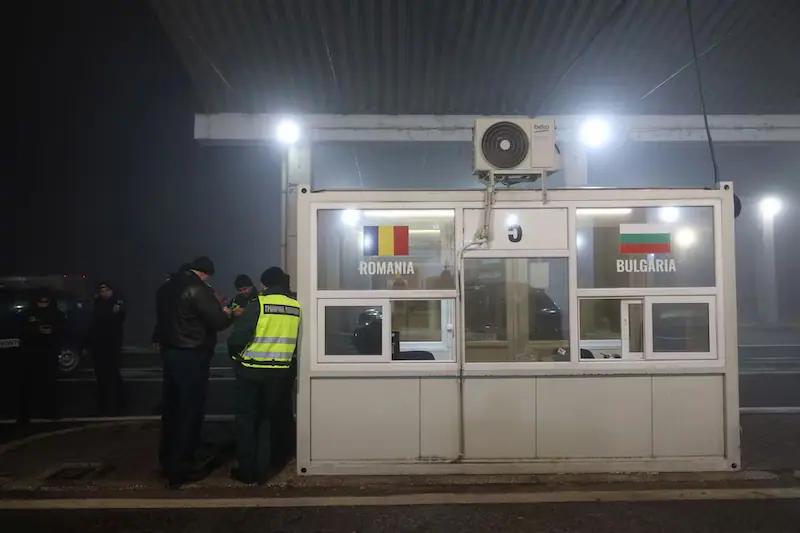


In a momentous occasion on Wednesday, Bulgaria and Romania officially abolished land border controls to become full members of the European Union's Schengen free-travel area. The celebratory event took place at a crossing near the Bulgarian town of Ruse, with fireworks illuminating the sky as the interior ministers of both countries raised a barrier on the Friendship Bridge spanning the Danube River.
Bulgarian Prime Minister Dimitar Glavchev hailed the occasion as historic, emphasizing the newfound freedom of movement that citizens will now enjoy from Greece to Finland, and all the way to Portugal. The crossing point at the Danube River is crucial for international trade, and the removal of border checks is expected to alleviate bottlenecks and facilitate smoother transit.
While checks on air and sea travel from Bulgaria and Romania were lifted in March 2024, land checks persisted until recently when Austria withdrew its veto, citing concerns over irregular migration. The Schengen area, initiated in 1985 with the elimination of border controls between France, Germany, Belgium, the Netherlands, and Luxembourg, has now expanded to include 25 of the 27 EU member states, along with Iceland, Liechtenstein, Norway, and Switzerland.
This development marks a significant step towards integration and cooperation within the EU, fostering greater connectivity and unity among European nations. Despite the ongoing challenges and disparities, the expansion of the Schengen zone reflects a commitment to shared values of openness, cooperation, and free movement across borders. Ireland and Cyprus remain outside the Schengen zone, delineating the boundaries of this evolving European landscape.