


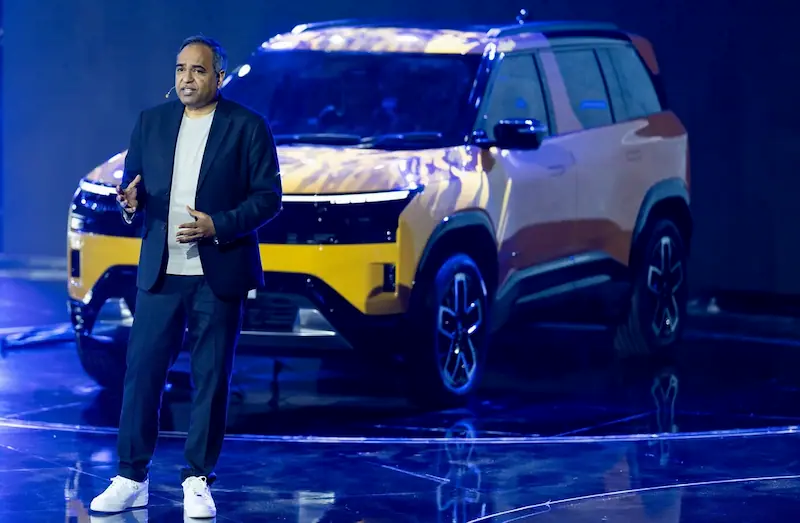


Amidst a shifting automotive landscape, Tata Motors Ltd. has announced a noteworthy development in the world of electric vehicles (EVs) - the cost of producing them is on a downward trend. This reduction in manufacturing expenses is primarily attributed to the declining prices of batteries, bridging the once-significant gap between EVs and traditional fossil-fuel vehicles. Shailesh Chandra, the managing director of Tata Motors' passenger vehicle and electric mobility division, elaborated on this pivotal shift at the Bharat Mobility Global Expo 2025 in New Delhi.
Chandra's remarks underscore Tata Motors' preparedness to engage in a potential price battle within India's burgeoning EV market, where the company currently holds a dominant market share of approximately 60%. With both global and local competitors gearing up to enter the EV sector, such as Hyundai Motor India Ltd. and Maruti Suzuki India Ltd., the landscape is set for intensifying competition. Hyundai Motor India's recent launch of its inaugural mass-market EV at a competitive price point mirrors this trend, further amplifying the industry's competitiveness.
Not to be outdone, Maruti Suzuki India unveiled its first EV and declared ambitions to seize the top spot in India's EV market by 2026, directly challenging Tata Motors' current leadership position. Embracing this evolving market dynamics, Tata Motors also introduced EV variants of its renowned Sierra and Harrier utility vehicle models, showcasing a commitment to innovation and versatility in product offerings.
The driving force behind this paradigm shift is the global decrease in battery prices, evening out the cost structures across the automotive industry. Chandra highlighted that this significant transition could potentially triple the market for EVs by 2025, setting the stage for immense growth and transformation in the sector.
Historically, two primary obstacles hindered widespread EV adoption - pricing and charging infrastructure. However, with the revised cost structures, EVs can now be competitively priced, while automakers are investing in building robust charging infrastructures. This dual-pronged approach is poised to propel the EV market forward, making it increasingly accessible to a broader consumer base.
Moreover, the expanding array of EV offerings in India underscores the sector's vibrancy and potential. A collaborative venture between India's JSW Group and China's SAIC Motor is set to release the electric sports car, MG Cyberster, with deliveries commencing in April. JSW MG Motor's EV Windsor has already witnessed robust sales, surpassing 10,000 units in the past three months alone, underscoring the growing consumer interest in EVs.
In conclusion, the gradual decline in EV manufacturing costs heralds a new era of competitiveness and innovation within India's EV market. As industry players gear up for heightened competition and expanded market opportunities, the future of electric mobility in India appears promising and full of potential growth.