


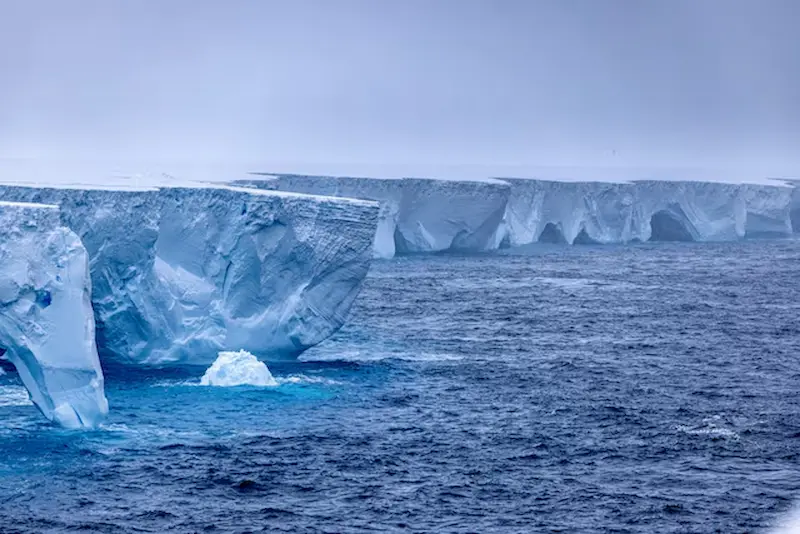


When people think about Antarctica, they often imagine an endless, frozen landscape that never really changes. White, silent, eternal. But according to a group of scientists who just published their findings in Nature, that picture is slipping away. The ice that rings the continent is shrinking quickly, in ways that go far beyond what anyone expected even a decade ago. And the frightening part is not just the melting itself, but what follows once the balance tips.
The researchers describe the situation as a kind of domino effect. They looked at all sorts of evidence — satellite data, yes, but also old ship records and ice drilled from deep below the surface. Taken together, the information shows that for centuries the Antarctic ice had a rhythm. It expanded, it retreated, always within certain limits. Recently, that rhythm has collapsed. The decline of sea ice isn’t just sharper, it’s also different in character, less predictable and far harder to stop.
Once the ice starts disappearing, the changes ripple outwards. With less white ice to bounce sunlight away, the dark ocean absorbs more heat. That heat melts more ice, which in turn affects major ocean currents. One of them, the Antarctic Overturning Circulation, acts like a conveyor belt for the planet’s climate, moving heat and nutrients around. If that conveyor slows, weather across the globe shifts. Rainfall, storms, even agricultural seasons could be reshaped far from the Southern Ocean.
But the crisis isn’t only about physics. It’s about life itself. Emperor penguins need stable ice to raise their chicks; without it, colonies collapse. Krill, those tiny creatures that seem insignificant but actually feed whales, seals, and fish, rely on the ice as well. Remove their habitat and the entire Antarctic food web begins to fray.
There’s also the invisible work done by phytoplankton. These microscopic plants float near the surface, pulling carbon dioxide out of the air. They are one of Earth’s most effective natural systems for trapping carbon. Warming waters reduce their numbers, which means more CO₂ stays in the atmosphere, which then drives even more warming. Another loop that reinforces itself.
Nerilie Abram, the lead author, put it in stark terms. Once Antarctic sea ice begins to decline beyond a certain point, the process feeds on itself. Even if humans manage to stop pumping carbon into the sky tomorrow, the ice could keep shrinking for centuries. Stabilizing the climate does not necessarily mean restoring the frozen south.
That doesn’t mean nothing can be done. The scientists emphasize that reducing emissions is still crucial. Slowing the pace of change matters. Every bit of warming avoided gives wildlife and ocean systems more time to adjust. But the study makes clear that some thresholds, once crossed, don’t allow for easy reversals.
For years, the spotlight was mostly on the Arctic, partly because its changes were visible and politically immediate — shipping routes, oil drilling, disputes over territory. Antarctica always felt distant, almost timeless. That perception is now proving dangerously misleading. The ice is going, and with it, one of the planet’s most important stabilizers.
The warning is straightforward but hard to swallow: the Earth system has tipping points, and Antarctic sea ice may be one of them. Once it’s lost, the world will not return to the climate it once knew.