


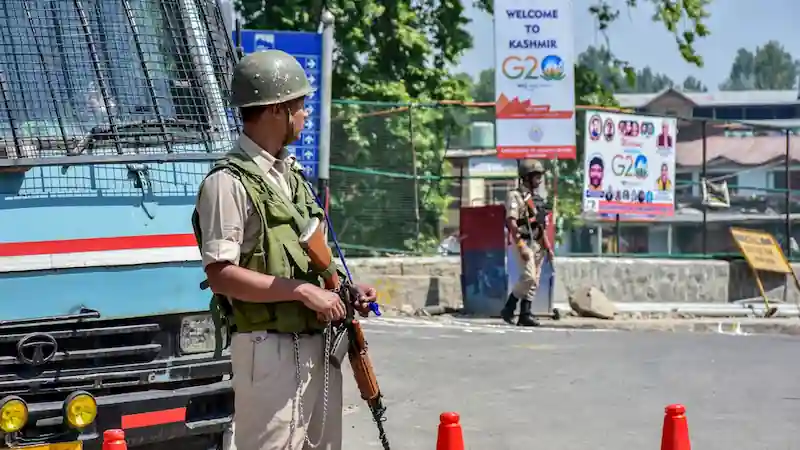


India has defended its decision to host an international tourism meeting for the Group of 20 (G20) in the disputed territory of Jammu and Kashmir, despite criticism from human rights groups and expected boycotts from several countries.
The meeting, scheduled to take place in Srinagar, the summer capital of Jammu and Kashmir, marks the first large-scale international event hosted in the Muslim-majority region since its special status was revoked by India in 2019. The move resulted in the division of the former state into two federal territories, with Ladakh being turned into a separate standalone territory, along with being a disputed region along the Line of Actual Control, a de-facto border between India and China. China stated its opposition to the meeting, saying it would not attend due to its opposition "to holding any kind of G20 meetings in disputed territory".
Relations between India and China have always been simmering with tensions, and have led to a number of border clashes. The most recent of these, which involved hand-to-hand fighting in 2020, claimed the lives of at least 20 Indian and four Chinese soldiers. Both sides have since deployed thousands of troops to the area, resulting in a stand-off that seems to be semi-permanent in nature.
The decision to hold such an event in Jammu and Kashmir has led several countries, including Saudi Arabia, Egypt, and Turkey, to boycott the event. The region is considered one of the most dangerous in the world, as both India and Pakistan claim ownership of the entire mountainous region; it has been the epicenter of a territorial struggle between the nuclear-armed neighbors for more than 70 years.
India has defended its decision, stating that revoking Kashmir’s semi-autonomy was necessary to ensure equal law for all citizens, increase economic development, and end separatism and terrorism allegedly aided and abetted by Pakistan. However, critics, such as the United Nations Special Rapporteur on Minority Issues, Fernand de Varennes, have said that India is "seeking to normalize what some have described as a military operation by instrumentalizing a G20 meeting" in a region where fears of human rights violations and violence are rife.
Despite this, India is keen to present itself as a leader of emerging and developing nations since assuming the G20 presidency. As the world’s largest democracy, with a population of more than 1.4 billion, India's political allies are keen to promote Modi as a key player in the global order. In April, Pakistan, which is not a G20 member, criticized India's decision to hold the tourism meeting in Kashmir, calling it "irresponsible".