


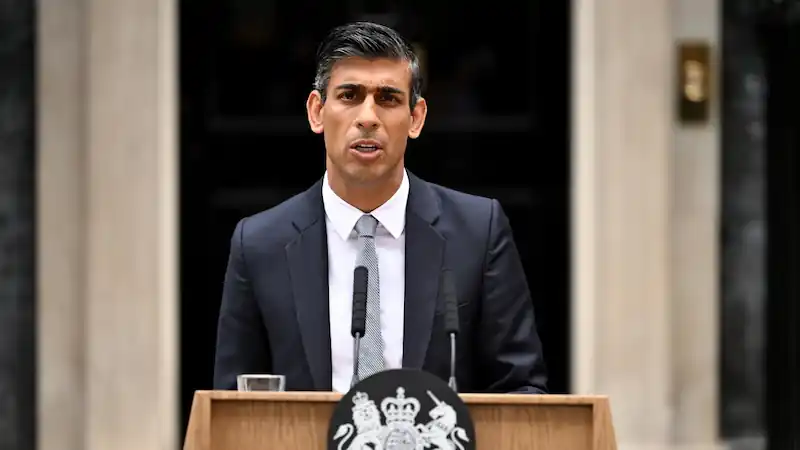


Despite recent economic successes, Rishi Sunak's, the current Prime Minister of the United Kingdom, political future remains uncertain due to the unstable nature of his support base. While the International Monetary Fund recently announced that the UK is no longer on the path to recession, inflation and energy prices are still falling at a slower than desired rate. Sunak has managed to stabilize economic conditions in the UK, but his Conservative Party is still rife with division, comprised of individuals who hold personal vendettas against one another.
Sunak became Prime Minister last year after Boris Johnson was forced to resign amidst a string of scandals. Sunak's decision to leave Johnson's cabinet was considered a betrayal by the former PM's allies, who continue to seek vengeance for his disloyalty. When Liz Truss contested Sunak for the position of Prime Minister, Johnson's supporters rallied behind her. However, her reign was short-lived, and she was soon replaced by Sunak, who has distinguished himself from Truss by adopting a more moderate political approach. Nevertheless, his conservative opponents still view him as a sellout and therefore a vulnerable target within his own party.
Two recent events serve as a reminder of the potential for Sunak's political downfall. The first event involves his decision on how to handle Suella Braverman, a member of the right-wing of the Conservative Party. When it was revealed that Braverman sought assistance from civil servants to avoid a speeding fine, Sunak found that her actions did not breach the Ministerial Code, thereby allowing her to retain her position. However, many within his party viewed this decision as an act of weakness, implying that he was unwilling to confront someone who is a stalwart member of the Conservative Party's right-wing, many of whom despise Sunak.
The second incident involves Boris Johnson, who, after references from the police, is suspected of having breached more COVID regulations than previously thought. Johnson's allies have accused Sunak of being behind the accusations, although Sunak has denied any involvement. With two people who could threaten Sunak's career in the limelight, contributions to positive economic news seem to have taken a backseat. Some of Sunak's supporters have also criticized him for having Braverman in his government in the first place; her resignation from Liz Truss's government for breaching the Ministerial Code is evidence of her political opportunism for any potential leadership position.
According to a senior Conservative MP, Sunak's lack of confidence in himself has made the Conservative Party's right-wing stronger in the long term. The risk for Sunak is that if the polls do not improve, some Conservatives may choose to retire and act on their accumulated grudges. A united party is essential for any party seeking to win an election, but with many Conservatives already abandoning ship, it may prove difficult for Sunak to win reelection.
In conclusion, while Sunak has improved the UK's economic outlook, his political future remains uncertain, as the Conservatives remain as divided as ever before. With the potential for a slow limp towards an election loss looming, Sunak must cautiously navigate through the fragile internal politics of his party if he wishes to remain in power.