


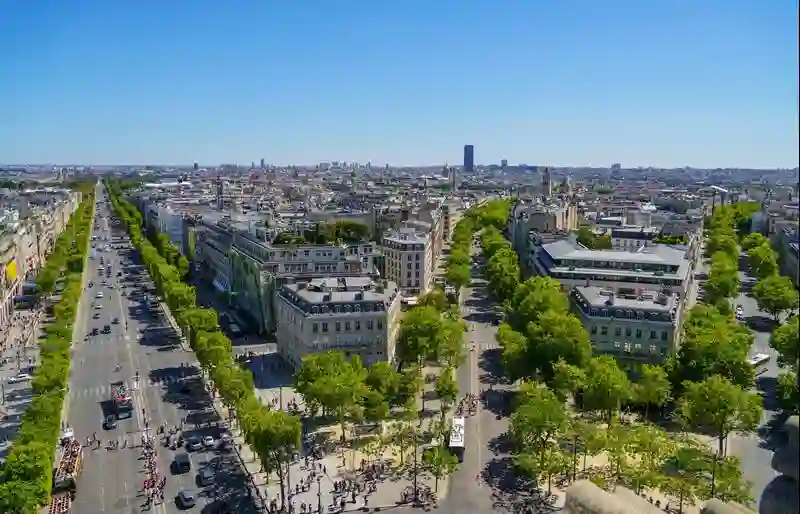


The city of Paris has historically planted trees along the streets that are beautiful and provide ample shade to pedestrians. However, as the city prepares for rising temperatures in the coming decades, it is now planning to consider a new factor: trees that are more resistant to heat. The deputy mayor for green spaces, Christophe Najdovski, said that they are going to diversify their trees ahead of climate change and an increasing number of heatwaves. They need species that will be able to handle the stress of not having water.
The Parisian's new urbanism plan includes planting 170,000 trees by 2026, and keeping them alive. Providing more green space is a core component of Mayor Anne Hidalgo’s vision for a “bio-climatic” city, which sees plants emerging from roofs and public squares, and the creation of more public housing. Pledges to plant more trees are a popular response in cities around the world for good reason. Trees absorb carbon, combat air pollution, and alleviate urban heat.
Officials are aware of the challenges associated with planting trees in an urban landscape, as lack of planning and funding for maintenance means that some trees don’t reach maturity. Climate change also plays a major role, as seen in Madrid and Copenhagen, where tree saplings have not adapted well due to drought and unexpected costs.
Paris officials are considering heat-resilient trees such as the Turkish hazel, the Montpellier maple, the European nettle tree and the holm oak, all of which are already present in the capital. They aim to avoid over-reliance on just a few species, which could make them more vulnerable to disease, and are studying other species that can be planted for the first time in Paris. A preliminary guide is already online, with suggestions on where each species could be placed as well as their water and sunlight needs. The city plans to expand the guide to include 180 species by the end of the year.
To ensure the survival of Paris’s newly planted trees, the city has a longstanding protocol to water them every two weeks for the first three years. Furthermore, around 100 new trees are equipped with probes to measure water stress, and they are supported by stakes and a metal girdle to protect them from dogs. Young trees require up to 50 liters of water a week, and the measures may ensure more trees make it through adolescence but might still put some new plantings at risk during the hottest, driest parts of the year.
Paris expects to reach a third of its tree-planting goal of 170,000 by the end of the planting season this year, and the new urbanism plan also calls for 300 hectares of additional green space, including a new park that would span the lower-income La Chapelle et La Villette neighborhoods at the northern edge of the city. The plan also aims to open up some private gardens, including those of the Val-de-Gra ce military hospital in the 5th arrondissement, and the former Reille convent in the 14th, to the public.
In conclusion, Paris is taking a proactive approach to climate change by planting climate-adaptive trees and investing in green spaces. The city's efforts to diversify its trees and ensure their survival are commendable and contribute to a sustainable future.