


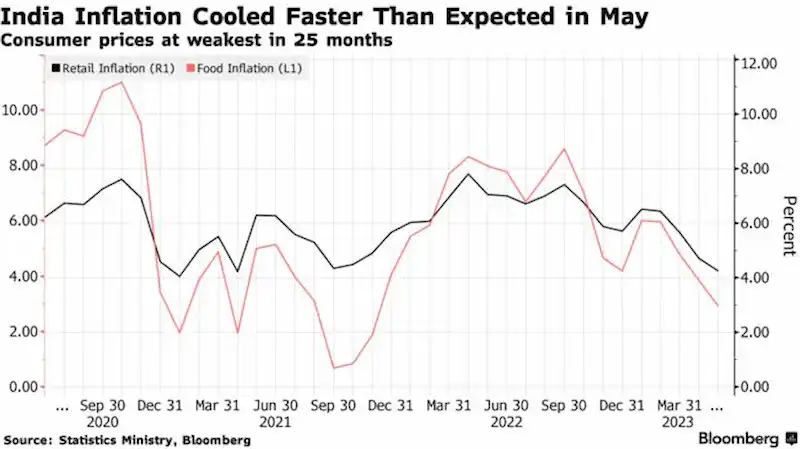


India's retail inflation rate has fallen faster than expected in May, alleviating concerns for policymakers despite the risks of an irregular monsoon. According to data released by the Statistics Ministry on Monday, the consumer price index rose by 4.25% compared to the same period last year. This was the lowest figure since April 2021 and lower than the median forecast of a 4.32% gain projected in a survey of economists by Bloomberg. The inflation print was at 4.70% in April.
The majority of the index is made up of food prices, which increased by 2.91%, and fuel and light prices, which rose by 4.64%. Clothing and footwear rose by 6.64%, whilst housing prices rose by 4.84%. Meanwhile, core inflation, which removes volatile food and fuel prices from the headline, dropped from 5.30% in April to 5.11% in May. Standard Chartered Bank economist, Anubhuti Sahay, noted that "the 25-month low CPI print, driven by factors beyond favorable base effect, is encouraging."
This development provides some relief for rate-setters seeking to align inflation with the Reserve Bank of India's (RBI) 4% target on a sustainable basis. The central bank has set inflation targets within a range of 2%-6%. At its latest meeting, the RBI retained its "withdrawal of accommodation" stance but highlighted concerns over the need for vigilance on price pressures.
There remains the risk of El Nino affecting normal rains in India leading to inflation. The unpredictable weather conditions potentially increases the risk of food inflation, which could push the headline CPI closer to the upper threshold of the mandated band, according to Sahay. There is, therefore, an expectation of a "prolonged pause" by the central bank.
India's southwest monsoon, which irrigates around 50% of the nation’s farmland, has finally arrived after the longest delay since 2019. However, it remains imperative that the interests of the domestic farmers and industries are well-balanced with the spread of the rains. Deficient rainfall could threaten rural incomes, lower the domestic consumption, and increase inflation in the long-run. These factors will be crucial in determining future-rate cuts.