


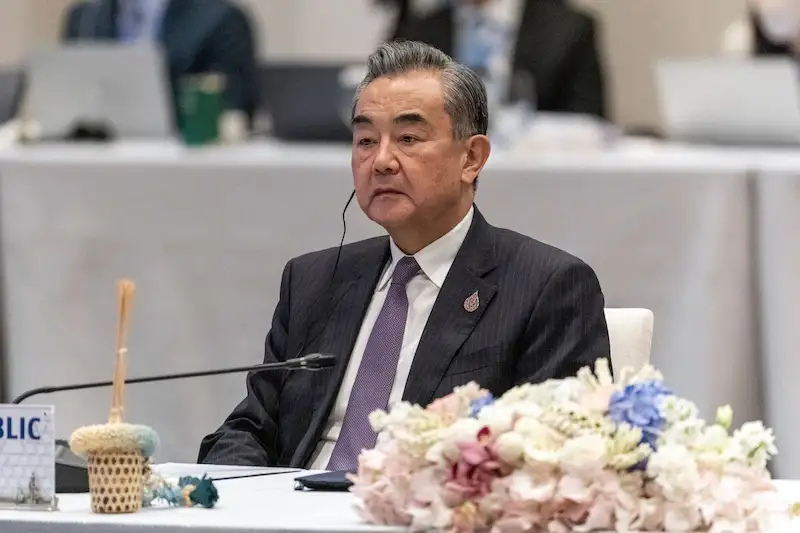


China's foreign minister, Qin Gang, has been unexpectedly replaced after a mysterious absence from public view since June. This sudden personnel change comes just seven months into his tenure, making it the shortest-ever for a foreign minister in China. The announcement was made by the nation's top legislative body at a snap meeting, with no explanation given for the abrupt change.
Qin Gang's predecessor, Wang Yi, will be stepping back into the role of foreign minister. However, it remains unclear whether Qin will retain his position as state councilor, a more senior title. This unexpected reshuffling of personnel follows a meeting of China's top decision-making Politburo, where economic policy and other issues were discussed. The lack of information surrounding Qin's absence has led to speculation about his official status, and the Chinese foreign ministry has declined to comment on the matter in recent weeks.
The information vacuum surrounding Qin's disappearance raises concerns among investors about data gaps and policy volatility in China, especially as the country's post-pandemic recovery faces challenges. While it is possible that Qin's absence is due to illness, China is known for its guarded approach to the health status of its leaders. This unexpected reinstatement of Wang suggests that it may be an interim decision in the event of Qin's recovery from a serious illness.
The switch in personnel is unlikely to have a significant impact on China's foreign policy, as it is ultimately determined by President Xi Jinping. Wang, who heads the Communist Party's foreign affairs panel, had been deputizing for Qin at international events in recent weeks, albeit somewhat awkwardly. Trips by foreign officials from the UK and the European Union were postponed due to Qin's absence.
The reintroduction of Wang into the role of foreign minister could pose challenges for President Joe Biden's efforts to rebuild relations with China. When US Secretary of State Antony Blinken met with Wang in Beijing last month, the meeting was tense, with the Chinese diplomat laying blame on Washington for the strained bilateral ties. In contrast, Qin had shown a more moderate approach, fostering a casual rapport with Blinken during their lengthy meeting.
It remains to be seen whether Qin Gang will return to Chinese politics or public view at all. His prolonged and unexplained absence could carry risks for President Xi Jinping, who handpicked Qin for the role last year amid a wider effort to install loyalists in key positions. The sudden downfall of Qin raises questions about why he was promoted in the first place and could create political problems for Xi. The lack of transparency surrounding Qin's situation is highly unusual, as the Chinese government typically provides reasons, such as an investigation or health issues, for a minister's removal.
Overall, China's abrupt replacement of its foreign minister and the secretive nature surrounding Qin's absence highlight the opaque inner workings of Chinese politics, leaving many observers puzzled and speculating about the underlying reasons for the sudden change.