


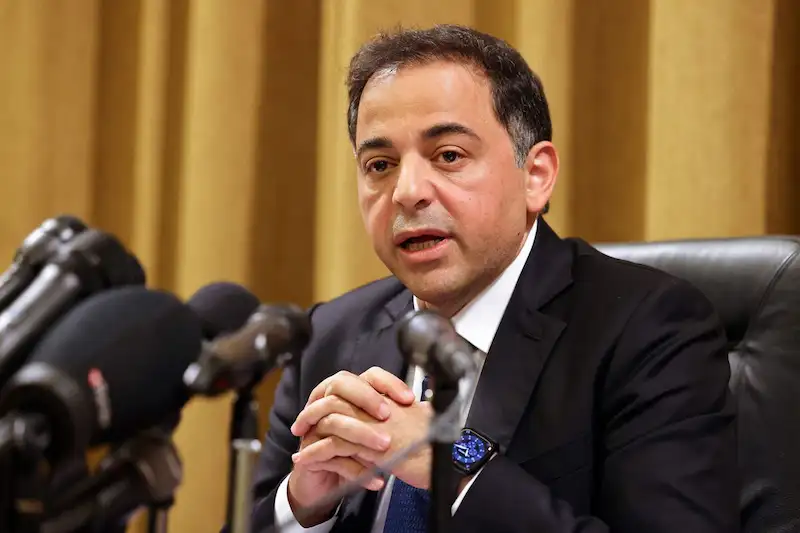


Lebanon's Central Bank Deputy Assumes Interim Role Amidst Money Laundering Allegations. In the wake of numerous money-laundering allegations, Lebanon's central bank is undergoing significant changes as its longtime governor, Riad Salameh, steps down from his position. Wassim Mansouri, the first vice-governor, has announced that he will temporarily take over as the interim governor, commencing his responsibilities immediately. Mansouri has already expressed his intention to initiate discussions with the state regarding the decision to float the pound's exchange rate.
Lebanon is currently grappling with a severe financial crisis that the World Bank has labeled as one of the most severe worldwide since the mid-19th century. The country's banking sector is estimated to be facing losses of around $70 billion, the national currency has experienced a devaluation of over 90%, and Lebanon defaulted on its debt in 2019 for the first time in its history. To address these challenges, Banque du Liban (Bdl), in collaboration with the government, will establish a mechanism to gradually unify and float the national currency without intervention from the central bank. This approach is necessitated by limited available resources.
Bdl has been actively selling dollars to both individuals and companies with the aim of stabilizing the pound's market value and ensuring the continued flow of essential imports. However, despite these efforts, the financial crisis persists and requires immediate attention.
Meanwhile, Riad Salameh, the former governor, is currently under investigation by the European Union on allegations of money laundering. Additionally, an Interpol notice has been issued against him. Salameh has categorically denied these charges and vehemently stated that he did not misuse his authority during his tenure at the central bank.
According to legal protocols, the first vice-governor assumes the position of governor until a new appointment is made. Salameh has confirmed that he will not seek a new term, and the caretaker government has yet to announce his successor.
Salameh's tenure, which began in 1993, was mostly credited with maintaining the pegged exchange rate and fostering confidence in Lebanon's financial sector, despite recurrent civil conflicts. However, his legacy suffered a severe blow during the financial crisis that began in 2019.
Critics of Salameh hold him responsible for continuously funding the government and implementing the now-notorious financial engineering schemes that temporarily sustained the system. They argue that Salameh enabled the political elite, who repeatedly failed to enact meaningful reforms, further exacerbating Lebanon's economic and financial difficulties.
As Lebanon's central bank undergoes this transitional phase, it remains to be seen how the new interim governor and future leadership will address the pressing challenges ahead and steer the country towards much-needed economic stability and recovery.