


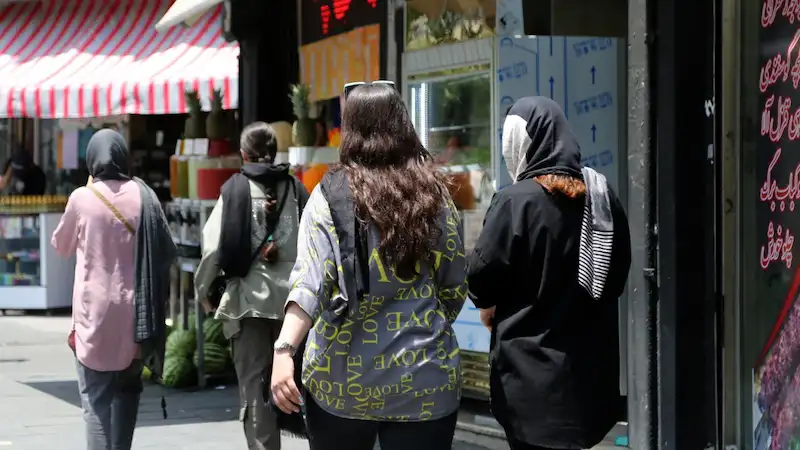


Iran is considering a new bill on hijab-wearing that could introduce some of the harshest punitive measures ever witnessed in the country. The draft law, consisting of 70 articles, proposes longer prison terms for women who refuse to wear the veil, strict penalties for celebrities and businesses that defy the rules, and the utilization of artificial intelligence to identify women who breach the dress code. While the bill has not yet been passed, experts argue that it sends a clear message to Iranians that the regime will not back down on its strict stance regarding the hijab, despite the mass protests that took place last year.
Last year, the death of Mahsa Amini sparked widespread protests across Iran. Amini, a 22-year-old Kurdish-Iranian woman, died after being detained by the regime's morality police and taken to a "re-education center" for allegedly not complying with the conservative dress code. Although the morality police had largely withdrawn following the protests, they recently announced their plans to resume detaining women caught without the Islamic headscarf in public.
The issue of hijab has long been a contentious one in Iran. The ban on hijab was initially implemented in 1936 by leader Reza Shah as part of his efforts to liberate women, but it was later lifted by his successor in 1941. In 1983, after the Islamic Revolution, the hijab became mandatory. Traditionally, the country's Islamic penal code considered the violation of the dress code as a minor offense, punishable by a maximum of two months in prison or a fine between $1.18 and $11.82.
However, the proposed bill seeks to reclassify the failure to wear the hijab as a more severe offense, carrying a prison sentence of five to ten years, along with a significantly higher fine of up to $8,508. This fine is beyond the means of many Iranians, considering that a significant portion of the population lives below the poverty line.
The bill also highlights the integration of artificial intelligence in enforcing the new law. It mandates the use of AI systems, such as fixed and mobile cameras, to identify individuals who violate the dress code. Additionally, the bill imposes harsher penalties on businesses that fail to enforce the hijab requirement, potentially leading to fines amounting to three months' worth of their profits, as well as travel bans and restrictions on participation in public or cyber activities for up to two years.
Moreover, the proposed legislation targets celebrities, who could face fines up to one-tenth of their wealth, temporary exclusion from employment or professional activities, and bans on international travel and social media engagement. The bill also aims to enforce stricter gender segregation in universities and public spaces, potentially fueling further unrest.
Some elements of this bill have already been unofficially enforced by the security forces. For instance, an insurance company in Tehran was closed recently after photos of female employees without hijabs circulated on social media. If passed, the bill would effectively legitimize these unlawful actions by the security forces.
While it is likely that the bill, or certain provisions within it, will pass through the regime-aligned parliament, it would still need to be approved by the Guardian Council, a powerful body that ensures legislation complies with Islamic principles and the Iranian constitution.
In conclusion, the proposed bill on hijab in Iran introduces extremely punitive measures, expands the use of AI surveillance, and takes a firm stance against those who defy the dress code. It is a clear response from the regime to the protests witnessed last year and signifies their unwavering commitment to enforcing strict hijab rules.