


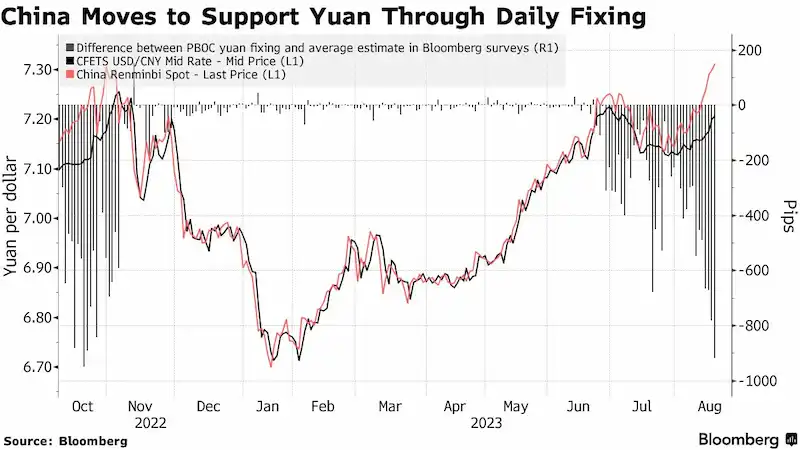


Chinese authorities have reportedly instructed state-owned banks to intensify their efforts to intervene in the currency market in order to prevent a surge in yuan volatility. The move comes as the yuan continues to fall towards a critical level of 7.35 per dollar, which is closely monitored by top Chinese leaders. In addition to stepping up intervention, senior officials are also considering implementing measures such as cutting banks' foreign-exchange reserve requirements to prevent a rapid depreciation in the currency.
It has been suggested that Chinese authorities are also investigating whether domestic companies have played a role in exacerbating the depreciation of the yuan through speculative trading against it. These measures come as China's markets experience a sense of gloom, despite attempts by Beijing to bolster sentiment with surprise interest rate cuts, daily reference rate adjustments for the yuan, and injections of short-term cash into the financial system. Despite these efforts, the onshore yuan is approaching its weakest level since 2007, and the key index of shares in Hong Kong is on the verge of entering a bear market.
In its monetary policy report, the People's Bank of China stated that it will strongly prevent excessive adjustment in the yuan and that the foreign-exchange market is currently in line with fundamentals. The central bank expressed confidence in its ability to maintain the orderly functioning of the foreign-exchange market and reassured that Chinese policymakers have the necessary tools and experience to manage these challenges.
While the authorities aim to guide a stronger yuan fix, they also recognize the influence of market forces. The PBOC seems comfortable with a gradual depreciation of the yuan but intends to counteract sharp and significant movements. The offshore yuan saw some strengthening in response to the news, rising up to 0.5% against the dollar.
The effectiveness of the PBOC's preferred tool, the fixing, has been called into question as traders grow impatient with China's underwhelming economic data. As a result, the central bank may resort to additional measures in its fight against yuan bears. This could include reducing the amount of foreign currency reserves that banks are required to hold or introducing measures to make it more difficult and expensive to bet against the yuan using derivatives.
Overall, Chinese authorities are determined to maintain stability in the currency market and prevent excessive volatility in the yuan. They believe they have the necessary tools and confidence to navigate these challenges while supporting the export industry and managing capital outflows.