


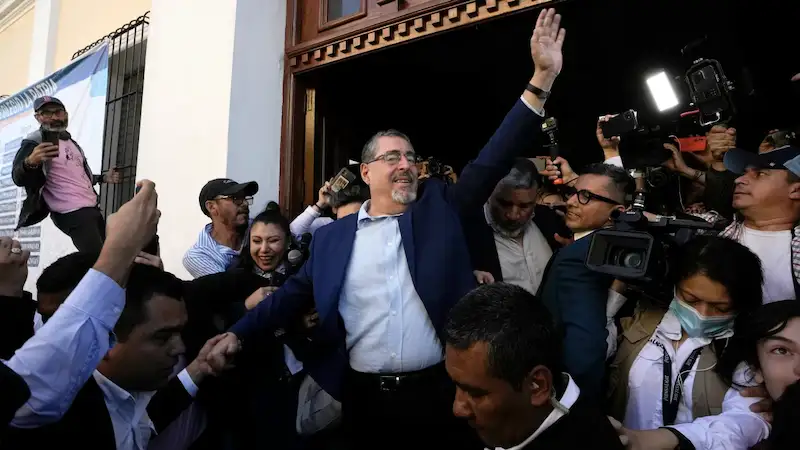


Bernardo Arévalo, an anti-corruption candidate from Guatemala's progressive Movimiento Semilla party, has emerged as the winner of the country's presidential election. According to preliminary results, Arévalo secured a majority, defeating former first lady Sandra Torres in a highly contentious race overshadowed by concerns of democratic regression.
In his remarks following the release of the preliminary results, Arévalo emphasized that the people have spoken resoundingly. He noted that the victory symbolizes a change in the mindset of Guatemalans, who are demanding an end to rampant corruption. Arévalo expressed hope for the country's future and celebrated the revival of hope among the people.
Arévalo has already received congratulatory calls from President Alejandro Giammattei, as well as the presidents of Mexico and El Salvador, further highlighting the significance of his win. With over 95% of the ballots counted, Arévalo secured 59.1% of the vote, while Torres garnered 36.1%, according to the Supreme Electoral Tribunal.
This victory is remarkable for Arévalo, a former diplomat, as he revitalized a race marred by controversy. Opposition candidates critical of corruption were disqualified by the state, drawing concerns from human rights groups and the international community. Arévalo's triumph signifies a rejection of corruption that has permeated various sectors of Guatemalan society.
Addressing the issue of corruption, Arévalo acknowledged that it has infiltrated institutions and spaces within society. He pledged to focus on reclaiming these spaces and combatting the pervasive issue. However, Arévalo's path to achieving his goals may encounter obstacles, as the Congress, which will largely be controlled by establishment parties, including Torres' Unidad Nacional de la Esperanza.
Analysts caution that efforts may be made to undermine Arévalo's victory, citing previous attempts to disqualify him following his surprise second-place finish in the first round of voting. Arévalo's Movimiento Semilla party was suspended by a Guatemalan court, based on allegations of falsifying citizens' signatures, a claim that Arévalo vehemently denies.
Arévalo's win comes at a time when Guatemala is grappling with rising corruption, inequality, and weakening rule of law, factors that have driven many Guatemalans to seek better prospects in the United States. The dissolution of the United Nations-backed anti-corruption commission, CICIG, in 2019 exacerbated the situation, leading to the arrest and investigation of prosecutors and judges associated with the commission.
The years following the commission's dissolution have seen high poverty and malnutrition rates in Guatemala. Additionally, members of the media critical of corruption have faced legal consequences, with prominent journalist José Rubén Zamora receiving a six-year prison sentence for money laundering this year, a move widely condemned as an attack on freedom of speech.