


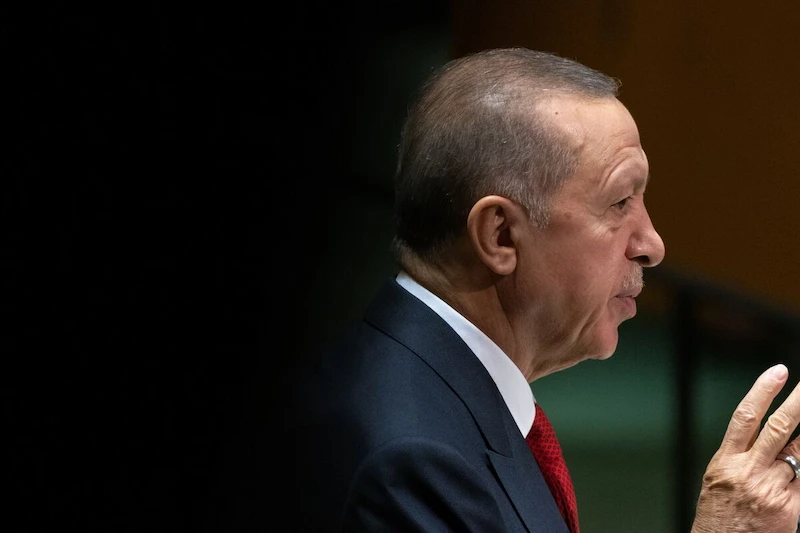


Turkish President Recep Tayyip Erdogan criticized the United States for sending a group of warships to the eastern Mediterranean, a move perceived as a show of solidarity with Israel. Erdogan questioned the presence of a US aircraft carrier in Israel during a joint press conference with Austrian Chancellor Karl Nehammer in Ankara, the capital of Turkey.
Expressing concern, Erdogan claimed that the US warships would potentially lead to "massacres" in Gaza. He also accused the US of aiding "terrorist" groups in the region, citing American presence in Syria. Erdogan's remarks highlight the strained relations between Turkey and the US, particularly over their differing approaches to the Israeli-Palestinian conflict and the Syrian crisis.
Relations between the US and Turkey have been tense for several years, with disagreements ranging from Turkey's military operations against Kurdish militants in Syria, whom the US supports, to Ankara's increasingly authoritarian policies. In October of last year, Turkey targeted US-backed Kurdish militants in Syria, citing them as responsible for a suicide bombing in Ankara. The US responded by shooting down a Turkish drone, further straining relations between the two NATO allies.
The recent escalation in tensions comes in the wake of a surprise attack launched by Hamas militants on Israel over the weekend. As a member of the NATO military alliance, Turkey's criticism of US actions in relation to Israel and the Palestinians adds another layer of complexity to the situation.
Erdogan's stance on the Israeli-Palestinian conflict is rooted in his support for the establishment of an independent Palestinian state, with its capital in East Jerusalem. He insists that this is crucial for achieving long-lasting peace in the volatile Middle East region. In an effort to de-escalate tensions, Erdogan has been engaging in diplomatic conversations with various regional leaders, including a recent phone call with Russia's President Vladimir Putin.
During the call, Erdogan and Putin discussed potential measures to prevent the further spread of tension in the region. These discussions are part of Turkey's larger efforts to assert its influence and promote stability in the Middle East.
As the situation in the Middle East remains precarious, Erdogan's criticism of US policies towards Israel and Palestine underscores the deep divisions between the two countries. It also sheds light on the complex web of alliances and rivalries at play in the region. The repercussions of these tensions could have far-reaching consequences for diplomatic relations and the pursuit of peace in the Middle East.