


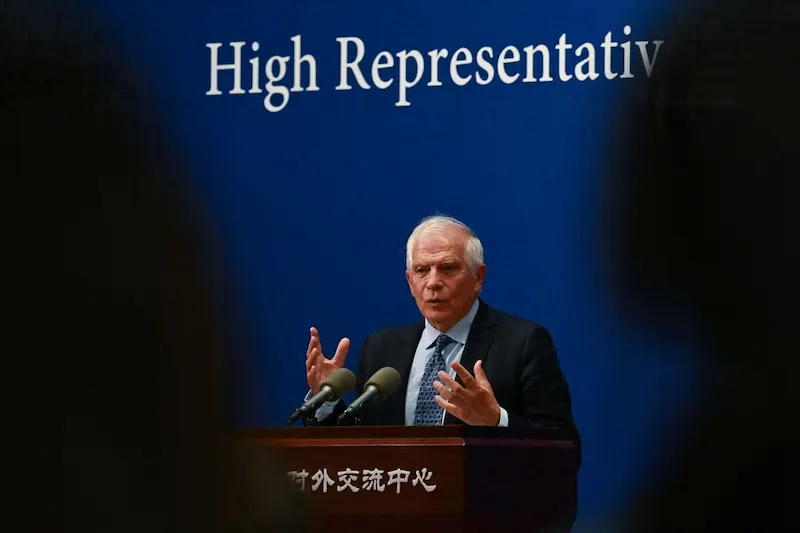


The European Union's top diplomat, Josep Borrell, has concluded his three-day visit to China, during which he discussed a range of issues, including the Middle East and bilateral ties. As a follow-up to the talks, the EU will now send its political director, Enrique Mora, to Beijing next week for additional discussions with Chinese officials. Borrell stated that the main focus of the talks was on resolving the Middle East conflict, with both sides agreeing that a two-state solution is the only viable long-term option.
Importantly, Borrell emphasized that the EU's relationship with China is independent of its relationships with other nations. In a speech delivered to university students in Beijing, he expressed concerns about eroding trust with China due to Beijing's stance on the conflict in Ukraine. Borrell urged China to step up its efforts to persuade Ukraine that it is not aligned with Russia. He also called on China to increase humanitarian assistance to Ukraine.
One of the key grievances raised by the EU is that China has provided diplomatic cover for Russian President Vladimir Putin in relation to the invasion of Ukraine. Borrell's comments echoed the criticism previously voiced by other EU officials, who accuse China of breaching its principles on territorial integrity by failing to condemn Russia's actions. The close ties between Moscow and Beijing are exemplified by Putin's expected attendance at President Xi Jinping's Belt and Road Forum in the coming days.
Borrell's visit to China comes after two previously planned visits were canceled due to various reasons, including his positive Covid-19 diagnosis and China's sudden cancellation of a scheduled meeting. This demonstrates the challenging dynamics surrounding diplomatic engagements between the EU and China.
Addressing the trade imbalance between China and Europe, Borrell urged China to take action. The trade surplus has significantly increased during the pandemic, as European countries imported more goods such as personal protective equipment and electronics. Borrell stressed that if the trade imbalance is not addressed, there is a risk of imposing drastic protectionist measures by the EU. Wang Yi, the Chinese Foreign Minister, acknowledged the EU's concerns and stated that China would work to create a more favorable business environment for European companies.
Additionally, China plans to restore flights with the EU that were halted due to the pandemic. Wang also mentioned that China will send special envoy Zhai Jun to the Middle East to address regional issues. This development comes after Zhai's recent call for humanitarian support for the Palestinians.
In summary, Borrell's visit to China highlighted key concerns for the EU, including the Middle East conflict, China's stance on Ukraine, and the trade imbalance. The EU seeks to strengthen trust and cooperation with China while addressing these important matters. The upcoming discussions between the EU's political director and Chinese officials will further address outstanding issues and foster dialogue between the two parties.