




Over the past few decades, the scientific community has been piecing together evidence that links greenhouse gas emissions and global warming to the increasing occurrence and intensity of extreme weather events. While connecting climate change to a specific weather event at a particular time and place can be challenging, the advancements in scientific methodologies have made it possible to establish a clear correlation between individual heat spells, storms, floods, droughts, and wildfires with global warming.
Researchers rely on a multi-step process to determine whether a connection exists between climate change and an extreme weather event. Firstly, they classify the event as extreme by comparing it to historical observations of similar events in the same region. Then, computer models are employed to create two scenarios: one where carbon concentrations remain constant at a pre-industrial level, and another where actual concentrations are considered. By comparing the weather event in these two scenarios, researchers can determine whether global warming increased the likelihood or severity of the event. More than 71% of the 500 extreme weather events or trends analyzed since 2011 were found to have been influenced by global warming, according to CarbonBrief.org.
Heatwaves have emerged as one of the most directly linked phenomena to carbon pollution. The rising temperatures, combined with dryness and wind, also contribute to the escalation of wildfires in various regions such as the western US and Australia. The length of the US fire season has extended by two months since the 1970s and 1980s. Additionally, tropical cyclones (hurricanes or typhoons) have been found to be more intense, although not necessarily more frequent, due to global warming. Warmer water and moisture resulting from climate change provide additional fuel for these storms.
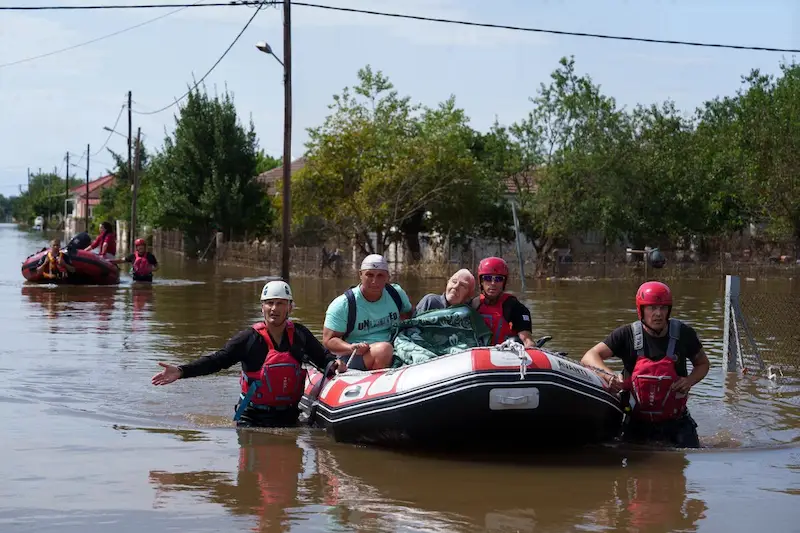
Recent weather events have provided further evidence of the impact of greenhouse gas emissions. For instance, scientists concluded that the scorching heatwave experienced in July 2023 throughout North America and southern Europe would have been nearly impossible without the influence of global warming. The extreme wildfires that ravaged eastern Canada during the same year were assessed to be 50% more intense and seven times more likely due to climate change. Additionally, flooding in South Africa in April 2022, resulting in hundreds of fatalities, was found to be twice as likely, while flooding in Libya in September led to over 11,000 deaths and was deemed 50 times more likely and as much as 50% more intense due to global warming.
Contrary to popular belief, global warming does not guarantee a reduction in cold weather. Winters have become shorter, and blizzards and extreme cold snaps have become less frequent. However, the warming of the Earth's poles at a faster rate than the rest of the planet disrupts the equilibrium between the equator's heat and the North Pole's cold, leading to unexpected outcomes. An example of this was the record-breaking cold that caused the Texas power grid failure in February 2021, triggered by the buckling of the polar vortex, which released frigid air across much of the US.
Looking ahead, since the mid-19th century, the Earth has already warmed by more than 1.1 degrees Celsius. According to the United Nations Intergovernmental Panel on Climate Change (IPCC), if current trends continue, we could reach 1.5 degrees Celsius, the threshold at which global warming becomes particularly dangerous, as early as the 2030s. As temperatures rise further, the intensity of extreme weather events is expected to grow exponentially. The IPCC warns that at 2 degrees Celsius of global warming, extreme weather events could double in intensity, and at 3 degrees Celsius, they could quadruple.
Beyond the fundamental changes to living conditions, the implications of global warming are also significant for the world economy. Numerous sectors, including agriculture, travel, and insurance, face risks associated with unpredictable and severe weather patterns. Estimates suggest that climate change accounted for a considerable portion of the losses caused by Hurricane Sandy in the US in 2012 and Typhoon Hagibis in Japan in 2019, amounting to billions of dollars in damages.
In summary, the mounting scientific evidence linking global warming to more frequent and severe extreme weather events underscores the urgent need to address climate change. As temperatures continue to rise, the ramifications extend beyond the environment, impacting both our everyday lives and the global economy. Taking action to mitigate greenhouse gas emissions is crucial to curb the escalating threats posed by extreme weather events.