


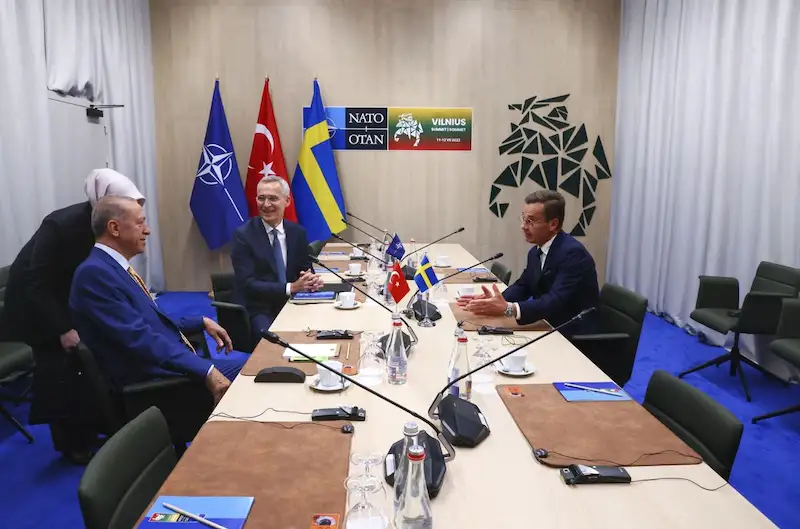


The Turkish parliament is expected to vote this week on Sweden's entry into the North Atlantic Treaty Organization (NATO), marking a significant step towards the completion of the alliance's Nordic expansion. The ruling AK Party, led by President Recep Tayyip Erdogan, will seek parliamentary approval for Sweden's long-awaited NATO membership. This move comes as part of a broader geopolitical strategy by Erdogan's administration, which is seeking to acquire new fighter jets and upgrade kits for its existing fleet.
The approval of Sweden's NATO membership by Turkey is a prerequisite set by US President Joe Biden for the sale of fighter aircraft to Ankara. Erdogan has underscored the interconnection between these two issues, stating that they can only be resolved together. With Turkey's approval, Hungary would remain the only obstacle to the completion of NATO's Nordic expansion, a process that has been pending for over a year and a half.
Sweden's entry into NATO will strengthen the alliance by reinforcing its northern reach and enhancing its capacity to defend its eastern flank. This follows Finland's admission to NATO last April. Finland and Sweden, historically non-aligned countries, applied for NATO membership in response to Russia's aggression in Ukraine. NATO membership provides the Nordic nations with a collective defense framework against external threats.
Last month, a key Turkish parliamentary committee supported Sweden's bid for NATO membership after Stockholm took steps to address Turkish concerns regarding the suppression of separatist groups, including the designated terrorist organization, the Kurdistan Workers' Party (PKK). Sweden has affirmed its compliance with NATO's membership criteria and has also implemented stricter laws against terrorism and lifted arms export restrictions to Turkey. However, Sweden's commitment to freedom of speech poses challenges for the government in curbing expressions of support for Kurdish independence.
The conflict between Russia and Ukraine has had far-reaching consequences in European geopolitics, leading to Finland and Sweden seeking NATO membership. For Russian President Vladimir Putin, NATO has long been viewed as a hostile alliance. With Finland's entry, NATO expands to 31 members and aims to deter any potential aggression against the Nordic countries.
Upon gaining full NATO membership, Sweden is expected to deploy hundreds of troops to Latvia to bolster the alliance's forces in the region. Currently, NATO has approximately 1,700 troops stationed in Latvia as part of its enhanced forward presence, resembling similar battle groups in other Baltic countries and Poland. The inclusion of Sweden will further strengthen NATO's presence in the Baltic region and enhance its ability to respond to potential threats.
The upcoming vote in the Turkish parliament signifies a crucial milestone in the accession process for Sweden's NATO membership. If approved, it would solidify NATO's reach in the Nordic region and contribute to the alliance's collective defense capabilities. The decision is not only significant for NATO's expansion but also for the geopolitical dynamics and security considerations in the Baltic region.