


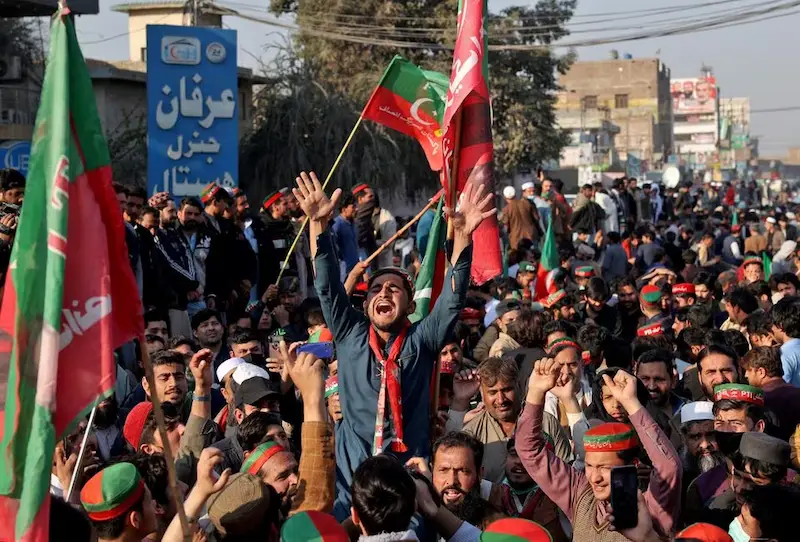


Backed by the party of jailed Pakistani opposition leader Imran Khan, candidates are preparing to form a government, according to a senior aide to the former prime minister. The nation of 241 million people voted in a general election on Thursday, amidst a struggling economy and ongoing militant violence. Both Khan and his main rival, former Prime Minister Nawaz Sharif, claimed victory, adding to the uncertainty surrounding the formation of the next government. In light of this, Khan's aide called on supporters to peacefully protest if final election results are not released.
Gohar Khan, the chairman of Khan's Pakistan Tehreek-Insaf (PTI) party and his lawyer, urged all institutions in Pakistan to respect his party's mandate. He stated that if complete results were not released by Saturday night, PTI would hold peaceful protests on Sunday outside government offices responsible for conveying election results throughout the country. In Peshawar, hundreds of Khan's supporters gathered, led by two of his aides who claimed they had been declared losers despite winning the polls. Protesting against alleged vote fraud, the supporters chanted slogans expressing their discontent.
Sharif's party, Pakistan Muslim League-Nawaz (PML-N), declared that they had emerged as the single largest group and would engage in talks with other groups to form a coalition government. However, by Saturday evening, the results for ten out of the 265 contested seats were still pending, 48 hours after the polls closed. The latest count, available on the election commission's website, showed that independent candidates had secured 100 seats, with PML-N taking 72. Notably, 90 of the victorious independent candidates were backed by Khan and PTI, placing them ahead of Sharif's party.
Independent candidates supported by Khan's party contested the elections as independent candidates since they were barred from using the PTI's electoral symbol due to non-compliance with electoral laws. Khan, despite being imprisoned on charges ranging from leaking state secrets to corruption, received significant support from his followers, although he cannot serve in the government while in jail. While independent candidates are not eligible for reserved seats, PML-N could potentially secure up to 20 of these seats.
Khan's media adviser, Zulfi Bukhari, announced that the party would soon reveal the banner under which they would ask independent candidates to join. In Pakistan, independent candidates cannot form a government on their own and must align with a political party. Notably, Bukhari expressed confidence that independent candidates who had endured oppression and torture during the past 18 months would remain steadfast in their support for PTI.
To form the next government, any political party would require support from others, as none of the major parties are close to achieving a simple majority in parliament. Besides Khan's PTI and Sharif's PML-N, the Pakistan Peoples Party of Bilawal Bhutto Zardari, the son of assassinated premier Benazir Bhutto, remains a key player with at least 53 seats. The remaining seats were won by smaller parties and independent candidates. This sets the stage for intense political negotiations in the coming days before a parliamentary vote can take place to elect a new prime minister and government.
Pakistan's army chief commended the successful conduct of the election on Saturday, asserting the nation's need for "stable hands" to overcome the politics of "anarchy and polarization." The military, a powerful institution in Pakistan, has historically played a significant role in shaping governments. Khan has accused the military of cracking down on his party, which the military denies. From his jail cell, Khan released an audio-visual message rejecting Sharif's claim to victory and calling on his supporters to celebrate their achievements despite alleged crackdowns and rigged polls limiting the success of PTI-backed candidates.
The United States, Britain, and the European Union expressed concerns over the electoral process and called for an investigation into reported irregularities. British Foreign Secretary David Cameron raised serious concerns about the fairness of the elections, while Pakistan's foreign office responded by underlining that the election had been successfully conducted and expressing hope that the process would effectively reflect the will of the people. Former Nigerian President Goodluck Jonathan, leading the Commonwealth team observing the election, encouraged those with grievances to address them according to the laws of Pakistan.